
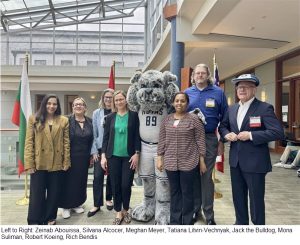
 On April 22, 2026, Georgetown University hosted its annual Research & Innovation Showcase, bringing together faculty, students, investors, entrepreneurs, and regional leaders for a full day focused on translating discovery into real-world impact. Held at the Rafik B. Hariri Building, the event centered on this year’s theme, “Partnerships Power Possibilities,” highlighting how collaboration drives innovation from lab to market.
“The 2026 Georgetown University Research & Innovation Showcase highlighted the need for strategic partners to achieve research translation and innovation development,” said Tatiana Litvin-Vechnyak, Georgetown’s vice president for technology commercialization. “This year’s event brought together more than 400 investors, entrepreneurs, industry stakeholders, faculty, and students, all critical to our ability to achieve this goal. BHI’s collaboration over the years and sponsorship of the showcase has been crucial to this work.”
BioHealth Innovation was well represented throughout the day, including Founder, President, and CEO Rich Bendis, Entrepreneurs-in-Residence Luis T. Gutierrez, Ray Blanchard, and Steve Wolpe, along with Mona Suliman, Life Sciences Business Strategist. Their presence reflects an ongoing collaboration between BHI and Georgetown that has been in place for several years, where BHI’s Entrepreneurs-in-Residence work alongside Georgetown’s Office of Technology Commercialization and Georgetown Tech Ventures to help evaluate, develop, and advance early-stage technologies toward commercialization.
The program followed a structured flow designed to move from high-level insights to active engagement, beginning with the “Discovery to Impact” opening panel, followed by research presentations, a reverse pitch session with industry and investors, a new venture showcase, and concluding with awards and networking.
The opening panel stood out as a defining moment of the event. Moderated by Georgetown’s Vice President of Technology Commercialization, Tatiana Litvin-Vechnyak, the discussion featured leaders who shared firsthand accounts of how academic research can evolve into FDA-approved products with real patient impact.
“The detailed stories shared during the opening panel made it clear how innovation that begins in an academic setting can successfully translate into therapies that reach patients well beyond the university,” said Luis T. Gutierrez, Entrepreneur-in-Residence.
Across the broader showcase, the diversity of innovation on display was a consistent theme. From cancer therapeutics to AI-enabled research platforms and socially driven ventures, the range of subject matter reflected both the depth of Georgetown’s research and the evolving priorities of the biohealth ecosystem.
“There was a strong variety of startup subject matter represented, which made the event both engaging and insightful,” said Mona Suliman. “The reverse pitch format, in particular, was a great idea and provided valuable insights into how companies and investors are thinking.”
The Industry and Investor Reverse Pitch session drew strong engagement from attendees, emphasizing early-stage conversations and relationship building. Many of the participating organizations were based within the BioHealth Capital Region, reinforcing the importance of local connectivity in driving innovation forward.
“This session really underscored the value of establishing early dialogue between innovators and funders,” noted Ray Blanchard. “It created a space for understanding priorities on both sides before formal investment conversations begin.”
The New Venture Showcase highlighted emerging companies built around Georgetown research, including Pushcart Therapeutics, where BHI EIR Steve Wolpe serves as CEO. A key moment from the session was the first public presentation of the company by Dr. Louis Weiner, Director of Georgetown’s Lombardi Cancer Center.
“The Georgetown showcase was an excellent mix of investors, strategics and Georgetown spinout companies,” said Steve Wolpe, Entrepreneur-in-Residence. “Dr. Weiner’s research was identified by BHI as having great potential for a spinout, and PushCART was co-founded to advance that opportunity. The company is developing DRILL technology that allows immune cells to penetrate solid tumors, and the preclinical data presented was compelling. We are currently closing a seed round with plans to enter first-in-human clinical trials within the next two years.”
The presentation underscored the role that structured partnerships play in advancing promising academic research into venture-backed companies with a clear path toward the clinic.
Beyond the formal programming, the event also benefited from strong participation across the Georgetown community, with attendees spanning faculty, students, alumni, and regional stakeholders. The presence of Nina Albert, Deputy Mayor of Washington, DC, added important context around public sector initiatives supporting innovation and investment across the region, including the city’s efforts to build a stronger venture and startup ecosystem.
“The networking session brought together a great mix of speakers and attendees,” said Suliman. “It created meaningful opportunities to connect across sectors.”
The day concluded with an awards ceremony recognizing innovation and entrepreneurship within the Georgetown community, reinforcing the institution’s ongoing commitment to advancing research with real-world impact.
“The strength of efforts like this is in the partnership,” said Rich Bendis. “As Georgetown continues to expand its startup pipeline and its collaboration with BHI, events like this reinforce that successful commercialization is built through sustained partnership, shared expertise, and consistent engagement across the ecosystem.”