
Category

News

From Can to Should: Reassessing Viability in 2026

By EIR Insights, News

Last year, I wrote a LinkedIn Article titled To be or not to be: Just because you CAN, doesn’t mean you SHOULD.” The point was straightforward. Passion and good science are not enough. They never really were. That post was a reaction to what I was seeing across early-stage biotech and MedTech at the time. The environment has not eased since then. If anything, the bar has moved higher.

The requirements for viability are more stringent today than they were even a year ago. Early-stage capital remains difficult to access, particularly at the seed and Series A stages, unless a company has human proof of concept. Angel investors want de-risking. Most venture funds will not underwrite the earliest technical risk. Government funding used to fill that gap. The uncertainty around the reauthorization of innovation investment programs has made it harder to hit commercially meaningful milestones at exactly the stage when companies need that support most. Until policy catches up, founders are forced to seek private capital that is increasingly selective and unforgiving.

This shifts the question founders need to ask themselves. It is no longer whether an idea is interesting or even whether it addresses an unmet need. The question is whether the idea can survive the current validation threshold. That threshold is no longer defined by enthusiasm or momentum. It is defined by evidence, timing, and a clear path to value creation that stands up to scrutiny.

Commercial realism remains the most common failure point. Founders and CEOs are almost always optimistic about their opportunity, and they should be. If the CEO is not the champion, no one else will be. The problem arises when optimism replaces rigor. Market size is often overstated. Competitive dynamics are underestimated. Pricing and reimbursement assumptions are built on hope rather than data. Real market assessments require primary customer discovery paired with precedent sales data, both top-down and bottom-up. They also require discipline about who the customer is and where adoption will realistically occur.

Differentiation has also changed. Incremental improvements used to matter. Slight changes in dosing or convenience could be enough in some cases, but that still holds only if the market signals that it values those changes. In many therapeutic and digital health categories, that bar has risen. The existence of a standard of care, even an imperfect one, changes everything. Workarounds that are cheaper and good enough are formidable competitors. A fourth- or fifth-line product rarely succeeds just because the total addressable market is significant. Investors are not persuaded by big numbers without a sophisticated explanation of what portion of that market is reachable and why.

Health economics can no longer be an afterthought. Payers are not focused on novelty. They are focused on sustainability. Cost effectiveness, total cost of care, and system-level impact matter early, not late. Clinical development strategies that ignore this reality tend to produce assets that struggle to gain traction even if they reach approval.

Manufacturing and supply chain considerations are now decisive factors in viability. Fully burdened cost modeling should be mandatory, not optional. Many promising concepts fail when exposed to the realities of sourcing, scale-up, tech transfer, and CDMO capacity. Lead times for specialized reagents, limited suppliers, geopolitical pressures, and competition from larger customers all introduce risks that can derail timelines and margins. Profitability estimates that are not grounded in real quotes and realistic assumptions are unreliable. A product that cannot be manufactured profitably at scale is not a product. It is an experiment.

Intellectual property expectations have also hardened. Venture investors continue to favor novel chemical entities with enforceable composition-of-matter claims. Method-of-use claims and simple repurposing strategies remain difficult to defend commercially. Off-label use, generic substitution, and payer resistance erode value quickly. Repurposing can be both capital and clinically efficient, but unless there is a credible way to lock the market through delivery technology, owned chemistry, or a pricing model that holds, it is rarely attractive to institutional capital. The irony is that some of the most efficient paths to patient benefit struggle the most under current investment models.

Clinical adoption risk extends far beyond efficacy. I look at alternatives already in use and ask who they fail and why. I look at early predictors of response and whether patient selection is feasible. I look at whose pain point is being addressed and whether that aligns across providers, patients, payers, and regulators. Evidence requirements vary by stakeholder, and the costs and time required to satisfy them must be modeled honestly. I also look closely at who makes the buying decision and how the product would be sold. Adoption fails as often for psychological and behavioral reasons as it does for scientific ones.

Deciding whether to move forward, pause, or walk away requires discipline. Founders need to evaluate unmet need, solution fit, market opportunity, IP defensibility, validation requirements, development and manufacturing plans, regulatory and reimbursement pathways, financial models, and exit logic together. Weaknesses in any one area can undermine the entire effort. The willingness to stop is not a sign of failure. It is a sign of judgment. In this environment, the threshold for validation is higher across the board, even in areas that remain attractive to pharma and investors.

This is where an experienced, external perspective matters. A short, focused conversation can surface gaps that would otherwise take years and significant capital to discover. Stress-testing assumptions early saves time, money, and energy. Not every idea should become a company. Not every asset belongs in a pipeline. The goal is not to build something at all costs. The goal is to build something that has a real chance of reaching patients and creating value along the way.

Being in the business of innovation means living with uncertainty and learning constantly. It also means making hard calls sooner rather than later. Just because you can still does not mean you should. The difference between the two has never mattered more.

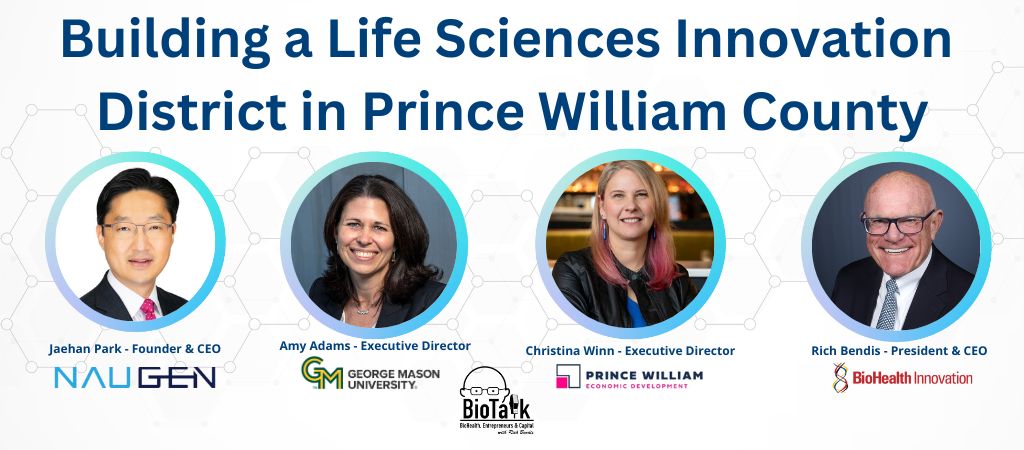
Building a Life Sciences Innovation District in Manassas, Virginia on BioTalk

By BioTalk with Rich Bendis Podcast, News

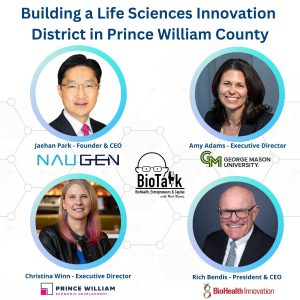
This episode of the BioTalk with Rich Bendis Podcast brings together leaders from industry, academia, and economic development to unpack the vision behind a new life sciences Innovation District anchored in Prince William County. With introductions to NAUGEN, George Mason University’s Institute for Biohealth Innovation, and the Prince William County Department of Economic Development, setting the stage for how each organization contributes to the district’s foundation. The guests discuss the life science assets, research strengths, and translational capabilities that define the district and explain why it is well-positioned to support biotechnology and advanced R&D companies.

The podcast explores how the partnership between Prince William County, George Mason University, and the City of Manassas came together, outlining the distinct roles each plays in advancing a shared strategy. The episode also introduces the NISA program, detailing how it supports companies seeking a soft-landing pathway into the district, the types of organizations best suited for the program, and the facilities, talent, and collaborative resources participants can access both immediately and over time.

Listen now via your favorite podcast platform:
Apple: https://apple.co/4p94Dqe
Spotify: https://bit.ly/3Y7dJZw
iHeart Podcasts: https://ihr.fm/3KLV7v4
Amazon Music Podcasts: https://amzn.to/4pajS1P
YouTube Music Podcasts: https://bit.ly/4phRV8I
TuneIn: https://bit.ly/44GoG7Y

Editing and post-production work for this episode was provided by The Podcast Consultant (https://thepodcastconsultant.com).

Jaehan Park is Founder and CEO of NAUGEN, a global innovation accelerator advancing novel technologies across life sciences and deep tech. With more than 25 years of experience in strategy and business development, he has led collaborations spanning cancer immunotherapy, vaccines, and biologics with global pharmaceutical companies and academic institutions. He leads the NISA Program in partnership with George Mason University and serves as a Mentor-in-Residence at KIC DC, supporting international startups entering U.S. markets.

Amy Adams is Executive Director of George Mason University’s Institute for Biohealth Innovation, where she advances biohealth research and innovation across more than 300 faculty and thousands of students. Her work focuses on partnerships, shared research infrastructure, and building hubs that connect academia with industry. She is co-leading the development of the Innovation District anchored at Mason’s SciTech campus and serves on the boards of BioHealth Innovation and the Association of University Research Parks.

Christina Winn leads the Prince William County Department of Economic Development, guiding investment, business growth, and redevelopment efforts across one of Virginia’s largest counties. She is overseeing the development of a research-driven Innovation District in partnership with George Mason University and the City of Manassas, supported by a GO Virginia grant. Her career includes leading large-scale economic development initiatives that have driven significant capital investment, job creation, and national visibility for the region.

Entrepreneurs in Residence Call: Biohealth Commercialization Leaders with AI and Quantum Experience

By News

BioHealth Innovation is expanding its Entrepreneurs in Residence (EIR) network and is seeking experienced leaders at the intersection of biohealth and advanced technologies, including artificial intelligence and quantum computing.
This call is for seasoned operators with a strong commercialization background. Ideal candidates have taken innovations from concept through market entry, licensing, spinout, or acquisition, and understand the realities of regulatory pathways, customer discovery, fundraising, and scale. Experience working with startups, academic technologies, government labs, or early-stage venture-backed companies is essential. EIRs serve in a part time advisory role with BHI, working flexibly alongside other professional commitments while contributing hands on commercialization expertise.

We are particularly interested in EIRs who can translate AI and quantum capabilities into practical biohealth applications, including drug discovery, diagnostics, clinical research, manufacturing, data analytics, and health system innovation. The role requires comfort working across technical, business, and stakeholder environments.

EIRs work closely with entrepreneurs, researchers, and partners across the BioHealth Capital Region and nationally. Engagements may include advising project teams, supporting partner initiatives, guiding commercialization strategy, and mentoring founders navigating early growth decisions.

This is an opportunity to contribute deep expertise to high-potential biohealth innovations while remaining connected to a collaborative, mission-driven ecosystem.

Interested candidates should contact BHI Founder, President, and CEO, Rich Bendis at rbendis@biohealthinnovation.org, with a summary of their background, commercialization experience, and areas of technical focus.


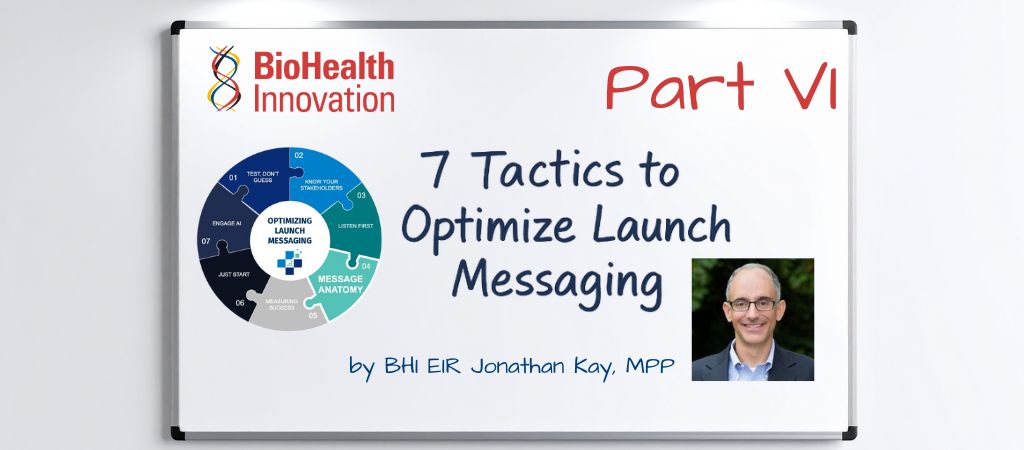
BHI EIR Insights: 7 Tactics to Optimize Launch Messaging – Part I

By EIR Insights, News

by Jonathan Kay, MPP, Managing Partner, Health Market Experts & BioHealth Innovation, Inc. Entrepreneur-in-Residence

Healthcare is complicated. Communicating effectively doesn’t need to be.

For a new medical technology, biologic, pharmaceutical, or digital health solution, a critical element of go-to-market strategy (GTM) and initial commercial success is messaging.

But messaging often doesn’t get the attention it deserves.

GTM messaging could include messages to any: physicians, hospital administrators, policy makers, patients, caregivers, payers, and more.

This post kicks off our 7-part series on Optimizing Launch Messaging 🚀, where we will share 7 valuable tactics to help achieve your goals related to access, commercial success, and improved patient outcomes.

Tactic 1: Test, Don’t Guess

The first step to optimizing launch strategy is embracing a data-driven mindset:

Healthcare markets are complex in so many ways. Think of the scientific, clinical, regulatory, reimbursement, and competitive landscape. Testing in a complex and changing environment helps minimize risk and maximize potential.

Companies run clinical trials to test the impact of a therapy. Similarly, commercial teams should test their launch communications to ensure they are effective and safe. That is, are the messages clear, credible, and persuasive? Do the messages avoid unintended consequences?

Why test messages? We test messages to:

  • Understand unmet needs
  • Assess competitive differentiators
  • Understand which messages resonate and why
  • Learn how to motivate appropriate behavior

Do you have a positive example from when you tested messages in advance of using them? Share your thoughts below!

At Health Market Experts, we make corporate and brand messaging more efficient and effective. If your organization is preparing to launch a product or a campaign, connect with us to learn more about how we can help you develop and execute your launch plan and maximize success. Ask us about message awareness and attribution, too.

This post was written with NI not AI (written by a human using natural intelligence).

This post expands on content I previously wrote as a blog at Catalant and delivered in guest lectures at Rutgers Business School.

Visit https://www.linkedin.com/in/jonathan-kay-healthcare/ to connect with Jon on LinkedIn.

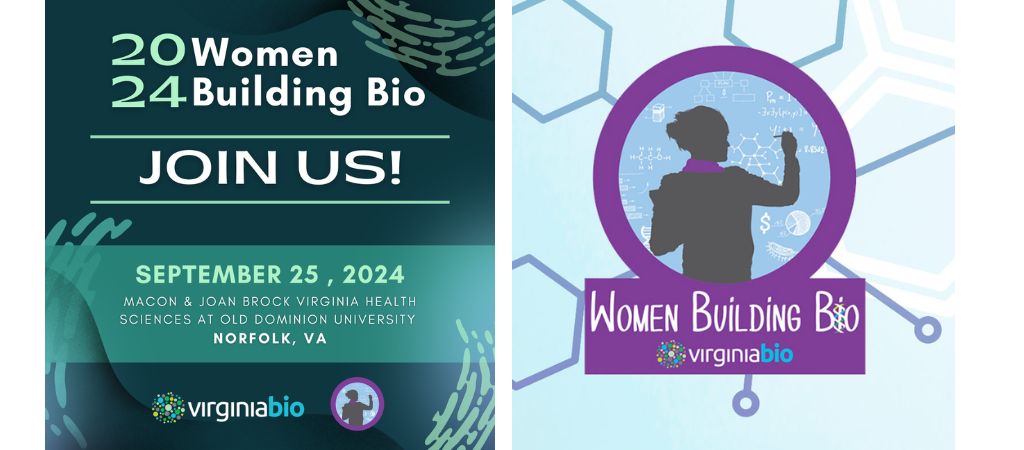
Strengthening Virginia’s BioHealth Future with Secretary of Commerce and Trade Juan Pablo Segura on BioTalk

By BioTalk with Rich Bendis Podcast, News

Secretary Juan Pablo Segura joins BioTalk for a conversation about Virginia’s growing position in the biohealth economy and the statewide strategy behind it. He outlines the significance of the new partnership with AstraZeneca, Lilly, and Merck, including up to $120 million in private investment to create a workforce development center and expand the Commonwealth’s life sciences capacity. Segura talks through how Virginia approaches company recruitment, what investors are responding to, and why the state is seeing increased interest from biomanufacturing and advanced R&D companies. He also discusses Virginia’s use of public-private partnerships to accelerate industry growth, strengthen the talent pipeline, and support emerging hubs across the Commonwealth. The conversation closes with a look at Virginia’s role in the BioHealth Capital Region and how the regional identity helps amplify the state’s message as it continues building a competitive biohealth ecosystem.

Listen now on your favorite podcast platform:
Apple: https://apple.co/3M2UNbB
Spotify: https://bit.ly/4izRPYa
iHeart Podcasts: https://ihr.fm/3Ktc0u5
Amazon Podcasts: https://amzn.to/3K5kkjN
YouTube Music Podcasts: https://bit.ly/4owIZfc
TuneIn: https://bit.ly/4ptw26O


Editing and post-production work for this episode was provided by The Podcast Consultant (https://thepodcastconsultant.com).

Juan Pablo Segura is the Secretary of Commerce and Trade for the Commonwealth of Virginia. He leads 13 agencies focused on economic growth, business development, and industry expansion across the state. Before entering public service, Segura spent his career building companies in the digital health sector, most notably as a founder of Babyscripts, a widely adopted maternity care platform. His work has been recognized by Startup Health, CTIA, EY, and the White House. He is a CPA and a graduate of the University of Notre Dame, and he lives in Henrico, Virginia with his family.

Activation Capital Names Michael Steele as President and CEO

By News

Accomplished life sciences executive to lead Virginia’s innovation ecosystem development organization into its next phase of growth.

Richmond, VA – August 26, 2025 – The Virginia Biotechnology Research Partnership Authority (doing business as Activation Capital) announced today that it has appointed Michael Steele as president and chief executive officer. Steele succeeds Robert Ward, who has served as interim CEO since July 2024 during a period of rapid growth for the life sciences ecosystem development organization.

Steele comes to Activation Capital with more than two decades of leadership experience in therapeutic, diagnostic, and research verticals across global markets. He has built and led high-performing teams, driven corporate strategy, and delivered growth through business development, mergers and acquisitions, licensing, investor relations, and strategic partnerships. Over his career, he has held senior leadership positions at fast-paced organizations, including Biocartis, Chembio Diagnostics, SeraCare Life Sciences, and Serologicals. Steele served in general management, corporate development, commercial, and operational roles, where he executed transactions generating hundreds of millions of dollars in revenue and investment. He has led global partnering initiatives to advance therapeutic, diagnostic and precision medicine innovations, negotiated agreements with top biopharma and life science companies, and directed strategies for large, growing organizations.

A Virginia native, Steele earned his MBA and a Bachelor of Science degree from James Madison University and completed the Senior Leadership Program at Vlerick Business School in Brussels, Belgium.

“Activation Capital’s mission depends on exceptional leadership, and Michael brings the vision, expertise and collaborative spirit needed to position the organization for even greater impact. We are excited to bring him on board,” said Michael Rao, president of Virginia Commonwealth University and chair of the Activation Capital Board. “I also thank Robert Ward for his dedicated service as interim CEO. Rob brought amazing energy, experience and leadership into his role; he streamlined infrastructure and processes, helped to achieve financial clarity and used his real estate expertise to guide the Board in understanding complex transactions.”

“Activation Capital’s continued success in advancing Virginia’s life sciences ecosystem depends on its ability to translate bold innovation into long-term, sustainable economic growth,” said Juan Pablo Segura, Secretary of Commerce and Trade for the Commonwealth of Virginia. “Under Michael Steele’s leadership, Activation Capital is well positioned to catalyze new partnerships, attract investment, and expand our regional impact further. I look forward to working together to ensure Virginia remains at the forefront of biotech innovation.”

“Michael brings deep experience in life sciences, business development, and strategic vision that will be a tremendous asset to Activation Capital and to Virginia’s innovation economy as a whole,” said Garrison Coward, board member of the Virginia Biotechnology Research Partnership Authority and Deputy Chief Transformation Officer in the Office of the Governor. “He clearly knows how to build partnerships, drive growth, and move organizations forward. That combination will help strengthen our position in biotech innovation across Central Virginia and the Commonwealth.”

Steele joins Activation Capital during a period of expansion and national recognition. Over the past year, the organization launched the Frontier BioHealth accelerator and showcase, welcomed its inaugural cohort of 10 high-growth startups, created Pioneer Connect, and expanded Start-the-Journey, a pre-accelerator for emerging founders. Activation Capital also secured a multimillion-dollar GO Virginia grant to scale biohealth sector development and earned recognition for its role in building an inclusive, high-impact innovation economy.

“I am energized and honored to lead Activation Capital at this pivotal moment,” said Michael Steele. “We’re building on a strong foundation, growing our programs, supporting even more entrepreneurs, and expanding our impact across the Commonwealth. In our mission of elevating Virginia’s life science ecosystem, my goal is simple yet impactful: create meaningful jobs and attract investments to catalyze our researchers, entrepreneurs, and partners to bring innovation to life, right here in the Commonwealth.”

About Virginia Biotechnology Research Partnership Authority

The Virginia Biotechnology Research Partnership Authority (“Authority”) is a political subdivision of the Commonwealth of Virginia created by Chapter 946 of the 1993 Virginia Acts of Assembly (the “Act”). The Authority disseminates knowledge pertaining to scientific and technological research and development among public and private entities, including but not limited to knowledge in biotechnology, and promotes industrial and economic development.

For more information, visit activation.capital.

MEDIA CONTACTS:

Leslie Strickler
leslies@etrecommunications.com

Paul Spicer
pauls@etrecommunications.com

Investigational Rosnilimab Emerges as a Novel, Differentiated Treatment Option for Rheumatoid Arthritis

By News
Investigational Rosnilimab Emerges as a Novel, Differentiated Treatment Option for Rheumatoid Arthritis

Rosnilimab, a selective depleter of pathogenic T cells, is a potential game changer for the treatment of moderate-to-severe rheumatoid arthritis (RA).

In a new Phase 2b clinical trial, rosnilimab demonstrated rapid symptomatic improvement driving patients into low disease activity (LDA) across diverse patient populations, including difficult-to-treat patients, by three months that continued to improve through six months. The data further indicated these responses were durable for at least three additional months off-drug. Rosnilimab also demonstrated favorable safety and tolerability, particularly when compared to the safety profiles of standard of care biologics or JAK inhibitors.1

“Witnessing rosnilimab, with its novel mode of action, dramatically reduce RA disease activity through six months in most patients, whether having failed biologic or targeted synthetic disease-modifying anti-rheumatic drug (b/tsDMARD) therapies or b/tsDMARD-naïve, is truly exciting for patients living with this disease and the field of RA treatment,” said Jonathan Graf, M.D., professor of Medicine, Division of Rheumatology at the University of California, San Francisco, and a lead investigator for the trial.

The U.S. RA market is valued at more than $20 billion. Even after patients have progressed on first-line biologics (anti-TNFs), the second line+ RA market generates more than $10 billion in annual revenue. For instance, rituximab, a B cell depleter with a significant adverse event profile including an increased risk of infection, prior to going off patent in 2018 and the entrance of biosimilars, achieved nearly $2 billion in annual RA sales. And today, despite biosimilar competition, it still maintains a significant share of last-line therapy sales in RA. Since 2012, no new treatment classes have been approved, and many RA patients cycle through different treatment therapies2, with up to a quarter not finding symptom relief.3

TEDCO Invests in AGED Diagnostics

By News

Biotechnology company developing early liver diseases detection technology

COLUMBIA, Md., (August 19, 2025) — TEDCO, Maryland’s economic engine for technology companies, announced a recent $250,000 Pre-Seed Builder Fund investment in AGED Diagnostics. Housed under TEDCO’s Social Impact Funds, the Pre-Seed Builder Funds provide investment and support to Maryland-based technology companies led by founders from economically underserved backgrounds.

“TEDCO’s funding continues to support us in furthering our research and development for early liver disease detection,” said Rachel Zayas, CEO of AGED Diagnostics. “With this follow-on investment, we hope to move closer to our mission of providing access to early detection and intervention care for those with liver disease.”

AGED Diagnostics, based in Rockville, Md., is a biotechnology company developing an early detection and intervention solution for liver disease. Using genomic innovation, the company is working to create a more accurate blood test that could keep patients in a monitoring program, helping to reduce financial burdens and improve patient outcomes.

“AGED Diagnostics seeks to tackle both the health and financial aspects of liver disease through their detection technology,” said Jean-Luc Park, deputy chief investment officer & senior director of TEDCO’s Social Impact Funds. “At TEDCO, we work to support innovative companies like this who are working towards impactful solutions; through the Pre-Seed Builder Fund, we are honored to offer more than just funding in support for our portfolio companies.”

TEDCO’s Social Impact Funds are just one of the many investment opportunities available to qualifying technology-focused startups and small businesses across Maryland.

“As technologies continue to evolve, it is always promising to see innovation in biotechnology seek to support more efficient and affordable healthcare,” said TEDCO CEO, Troy LeMaile-Stovall. “Being ranked as a top state for health care, Maryland has a fertile ecosystem for entrepreneurs and companies looking to advance in the medical landscape.”

For more information, visit our page at www.tedcomd.com/funding.

About TEDCO

TEDCO, the Maryland Technology Development Corporation, enhances economic empowerment growth through the fostering of an inclusive entrepreneurial innovation ecosystem. TEDCO identifies, invests in, and helps grow technology and life science-based companies in Maryland. Learn more at www.tedcomd.com.

###

Media Contact

Tammi Thomas, Chief Development & Marketing Officer, TEDCO, tthomas@tedcomd.com

Rachael Kalinyak, Associate Director, Marketing & Communications, TEDCO, rkalinyak@tedcomd.com

TEDCO’s Maryland Innovation Initiative Announces First Round of Baltimore Innovation Initiative Awardees

By News

The Baltimore Innovation Initiative awards a total of more than $645,000 to 14 awardees

COLUMBIA, Md., (August 18, 2025) — TEDCO, Maryland’s economic engine for technology companies, announced the first round of the Baltimore Innovation Initiative (BII) Pilot Program awardees, marking an important milestone for the organization. The BII Pilot Program falls under the Maryland Innovation Initiative (MII), fueling innovation and economic impact in the Baltimore region.

“The first round of BII awardees exemplify the innovation present throughout the Baltimore-Columbia-Towson Metropolitan Statistical Area,” said Abi Kulshreshtha, executive director, MII. “These awards will advance innovative technologies from seven colleges and universities, contributing to Maryland’s growing innovation ecosystem.”

The BII was created to support an equitable innovation and entrepreneurial ecosystem within higher education institutions in the Baltimore-Columbia-Towson Metropolitan Statistical Area (MSA). As part of Maryland’s matching contribution toward the Baltimore Tech Hub, the BII seeks to advance technology toward commercialization of a product or service and bolster support for entrepreneurs developing technology-based ventures.

“We received a number of excellent candidates – choosing the 14 awardees was a difficult process, but we feel these awardees are best positioned to utilize the funding provided to progress towards commercialization,” said Jalaycia Lewis, BII program manager.

The Technology Advancement Grant offers applicants support to commercialize a new or existing technology at an eligible institution while the Entrepreneurship and Commercialization Programming and Infrastructure Grant supports the creation or enhancement of entrepreneurship programs and commercialization infrastructure for technology-based ventures.

The eight Technology Advancement awardees include:

  1. Selena Shirkin,Fetal Therapy Technologies: Designing a novel port system for microsurgery; Johns Hopkins University
  2. Rebecca Greene,Semiautonomous Humanistic Algorithm for Reduced Effort and Enhanced Dexterity (SHARE2D) Control; Johns Hopkins University
  3. Anika Mistry,DevMinds: adaptive social-emotional learning to support neurodiverse kids beyond therapy sessions; Johns Hopkins University
  4. Oriol Cuxart,A breakthrough neuromodulation solution for Chronic Rhinosinusitis patients; Johns Hopkins University
  5. Michael Tangrea, advancing precision medicine through commercialization of the micropurification technology; Loyola University Maryland
  6. Kevin Tu, developing a secure and integrated fume hood management platform to reduce energy waste in research laboratories; University of Maryland, Baltimore
  7. Andres Londoño,DegreeMap: A smart degree planning platform for Maryland higher education; Towson University
  8. Debbie Sahlin, ACCESS-DP Advancing Coordinated Care and Emerging Smart Solutions for Disabled Populations; University of Maryland, Baltimore

The six Entrepreneurship Commercialization, Programming and Infrastructure Awardees include:

  1. Ian Ryu,AI Venture Studio Pilot; Johns Hopkins University
  2. Wendy Bolger, Support for the Baltipreneurs Accelerator; Loyola University Maryland
  3. Ryan Hoover, Launching the MICA Biodesign Program to Support and Diversify the Regional Bioeconomy; Maryland Institute College of Art
  4. Henry Mortimer,UBalt AI-Enabled Business Incubator; University of Baltimore
  5. Kenneth Wong,Center for Climate and Health Entrepreneurship; University of Maryland, Baltimore
  6. Jamie Gurganus,Embedding Entrepreneurial Mindset in Academia: Launching the Entrepreneurial Learning Lab at UMBC; University of Maryland, Baltimore County

“Innovative entrepreneurs thrive in Maryland with the support of programs like BII,” said TEDCO CEO, Troy LeMaile-Stovall. “As the number one state for minority-owned businesses, Maryland is moving the needle forward. By embracing diversity, we continue to see growth in a merit-based ecosystem that will not only bring the state to the forefront of innovation but will allow for sustainability.”

The MII was established as a collaboration between the State of Maryland and five academic research institutions, and leverages each institution’s strengths while promoting the commercialization of research conducted there. Since its inception, the program has invested more than $59 million in promising research commercialization, supported nearly 200 companies and generated almost 400 jobs. The success of the MII led to several pilot programs that expanded MII’s reach to two more comprehensive universities in addition to the creation of BII.

To learn more about the MII and BII programs, eligibility and application details, visit tedcomd.com/funding/maryland-innovation-initiative.

About TEDCO

TEDCO, the Maryland Technology Development Corporation, enhances economic empowerment growth through the fostering of an inclusive entrepreneurial innovation ecosystem. TEDCO identifies, invests in, and helps grow technology and life science-based companies in Maryland. Learn more at www.tedcomd.com.

###

Media Contact

Tammi Thomas, Chief Development & Marketing Officer, TEDCO, tthomas@tedcomd.com

Rachael Kalinyak, Associate Director, Marketing & Communications, TEDCO, rkalinyak@tedcomd.com

Building Maryland’s BioHealth Future: Maryland Commerce’s Stefanie Trop on Growing the Life Sciences Sector

By BioTalk with Rich Bendis Podcast, News


In this episode of BioTalk with Rich Bendis, Stefanie Trop, Ph.D., Director of Life Sciences at the Maryland Department of Commerce joins the conversation to discuss Maryland’s position as a leading life sciences hub. Stefanie shares how the Department of Commerce supports company attraction and growth through programs like Global Gateway, and how it’s amplifying the state’s recent #3 biopharma hub ranking. The discussion also explores Maryland’s unique ecosystem, including the work of the Governor’s Life Sciences Advisory Board, the state’s leadership in computational health, and the importance of industry collaboration during BioHealth Capital Region Week.

Listen now on your favorite podcast platform:
Apple: https://apple.co/4oHp9Po
Spotify: https://bit.ly/4fEIooK
iHeart: https://ihr.fm/4fGY3UL
Amazon Podcasts: https://amzn.to/47Awvya
YouTube Podcasts: https://bit.ly/3V7rJAI

Editing and post-production work for this episode was provided by The Podcast Consultant.

Dr. Stefanie Trop brings a unique blend of hands-on scientific expertise and high-level strategic insight. With a Ph.D. in Molecular Microbiology and Immunology, she has worked at the ground level in immunology, clinical trials, and vaccine development, while also driving growth through scientific partnerships and business development. Her deep understanding of the science and passion for problem solving guides her ability to build effective collaborations that advance both innovation and commercial success.

At the Maryland Department of Commerce, Stefanie works to connect Maryland’s life sciences companies with national and global resources, expanding the industry’s impact at home and globally. In current and prior roles, she bridges communication gaps between scientific and business teams, ensuring that customer needs translate into innovative products and business wins.

Search

You have successfully subscribed to the newsletter

There was an error while trying to send your request. Please try again.

BioHealth Innovation will use the information you provide on this form to be in touch with you and to provide updates and marketing.