Tag

non-dilutive funding Archives - BioHealth Innovation

The SBIR/STTR Program Is Paused. Here’s How to Use the Time.

By News

By Jon Nelson, BHI Director of Client Engagement: The SBIR/STTR program is currently paused pending reauthorization. However, there is a light at the end of the tunnel. On April 2nd, the Small Business Innovation and Economic Security Act was presented to the President for his signature. Three different outcomes now lay before us.

  • The President could sign the bill into law.
  • The President may choose to neither sign, nor veto the bill, in which case, the bill will automatically become law on April 14th.
  • The President could veto the bill. In this situation, the bill would return to Congress, where a two-thirds majority would be needed in both houses in order to override the veto.

For companies that have been relying on federal funding as part of their near-term financing strategy, the pause is a genuinely difficult disruption. Plans are delayed, timelines shift, and the natural response is to wait until there is more clarity especially when there are countless other priorities competing for attention. That instinct is understandable. However, the teams that emerge from this period in the strongest competitive position will be the ones that resist it.

While this is the first lapse in the SBIR/STTR program since its inception in the 1980s, other large funding opportunities and federal programs have seen similar pauses. Thus, history is instructive here – when a high-demand funding program goes dark and then reopens, submission volume typically reflects the backlog that accumulated during the gap. Companies that were mid-preparation when the pause began, teams that used the intervening time to get ready, and applicants who hesitated will all enter the queue at roughly the same time.

The result is a more competitive review environment. The bar for what constitutes a competitive proposal is effectively higher than it would be in a typical cycle, and where the difference between a thoughtfully developed application and one that was assembled quickly becomes far more apparent for reviewers to see.

What Good Preparation Actually Looks Like

For most applicants, the limiting factor in a competitive submission is not the quality of the underlying science. It is how clearly the proposal communicates that science to a review panel, how convincingly it is positioned within a credible commercialization strategy, and how clearly the proposal demonstrates that this team, with this approach, at this stage of development, is worth funding. Each of those elements takes longer to develop than most first-time applicants expect, and they each suffer when compressed into the final weeks before a deadline.

A strong commercialization narrative requires that holds up under reviewer scrutiny goes through multiple rounds of drafting and refinement. A technical approach that translates well on the page requires careful editing by individuals who understand both the science and reviewer expectations. A budget that avoids unnecessary scrutiny is one that has been reviewed with agency expectations and common pitfalls in mind.

The best time to do this work is now, before the pressure of an open submission window makes careful development difficult.

Getting the Most Out of the Time Available

Beyond the core proposal materials, there is meaningful preparatory work that is often deferred under deadline pressure. Reviewing and organizing preliminary data, identifying the most relevant solicitations to target when the program reopens, aligning internal stakeholders on project scope and budget, and stress-testing the overall narrative against likely reviewer questions are all tasks that benefit from careful attention that is hard to give them when a submission deadline is just around the corner.

This is also the right time to pursue the relationship-driven components of a strong application. Securing letters of support from key stakeholders, whether from clinical partners, academic collaborators, or potential customers, takes time and follow-up, and letters that are clearly written with care carry more weight with reviewers than ones that read as last-minute requests.

Similarly, identifying and formalizing relationships with contract research organizations or other external partners strengthens both the technical credibility of the proposal and the team’s demonstrated capacity to execute. These conversations take time , and teams that have already invested in them are at a clear advantage in a when the submission window reopens.

Working with BioHealth Innovation

At BioHealth Innovation, we work with early-stage founders and research teams throughout the full proposal development process, from identifying the right funding opportunity to building the commercialization narrative and finalizing technical and budget documents.

Teams that engage early enter submission cycles significantly more prepared. In a competitive environment, that head start can make big difference.

If you are serious about competing when the SBIR/STTR program reopens, the right time to start is now.

Contact us at jnelson@biohealthinnovation.org
AI in Grant Writing: Where it Helps and Where it Hurts

By EIR Insights, News

By Catherine Leasure, Ph.D., BHI Life Sciences Business Strategist – If you’ve written a grant recently, you’ve probably wondered whether AI could make the process easier. Maybe you’ve already tried it. The honest answer is that AI can help, but how much depends entirely on what you bring to it. When you know what you’re doing, it gets you to a solid draft faster. However, without a strong grasp of the process behind it, it can produce polished-sounding text that misses the mark in ways that aren’t always obvious until a reviewer or experienced grant writer points them out.
Where AI Earns Its Keep

The tasks where AI performs best are the ones that are time-consuming but relatively mechanical. Generating a document outline that accounts for both grant requirements and your specific project content is a good example. What might take an hour of cross-referencing a funding opportunity announcement can be done in minutes with the right prompt. From there, AI can help turn that outline into a working first draft and translate dense technical language into plain descriptions for non-specialist reviewers, which is particularly useful when generating ancillary documents like abstracts or project summaries that need to be accessible to a broad audience.

AI also shines in the later stages of drafting. Grant applications are long documents, and inconsistencies are easy to overlook when you’ve been working on the proposal for weeks or months. Terminology that shifts between sections that were written by different people, early claims that aren’t fully supported later in the document, and overly wordy sentences are all the kinds of issues that AI excels at catching and fixing. It can also serve as a compliance checker, making sure required sections are present and that the structure of your application matches what the solicitation requires.

None of this replaces the thinking that goes into a competitive application. But it does free up time and mental energy for the parts that require it.

Where AI Falls Short

The same confidence that makes AI useful in the drafting process can work against you when the content and strategy require nuance. AI can misrepresent novel technologies, fabricate citations, or produce technically plausible descriptions that are subtly wrong (this is called hallucinating). For early-stage companies with innovative science, this is a real risk. AI can only work with what you give it. If you’re not providing detailed, accurate information about your technology and approach, it will fill in the gaps on its own, and not always correctly. You need someone who actually understands the technology both guiding the prompts and reviewing anything AI generates before it goes into your final draft.

Beyond accuracy, there’s a layer of strategic knowledge that AI doesn’t have access to. It can’t tell you how a program officer has been framing their priorities in recent conversations, what a review panel tends to weigh most heavily, or whether your project is actually a good fit for a particular solicitation before you invest time writing your proposal. That kind of information comes from reaching out to and meeting with program officers before you submit. These conversations can reshape an application in ways that no AI tool can replicate.

Then there’s the writing itself. Even the best prompts can produce text that experienced reviewers recognize immediately: sentence structures like “it’s not X, it’s Y,” excessive adjectives, and the overuse of certain punctuation are all patterns that show up repeatedly in AI-generated text. Beyond the stylistic tells, AI tends toward a kind of confident vagueness that sounds thorough but doesn’t actually say much. In competitive grant programs, that kind of generic writing loses. If AI contributes to any part of your draft, it’s the grant writer’s job to make sure the final product sounds like it was written by a real person. Reviewers who are engaged with your writing are more likely to be engaged with your science.

Finally, using AI to write your grant poses a potential confidentiality risk that often goes overlooked. When you paste proprietary information about your technology into a public AI tool, that content may be used to train the model, and there is no guarantee it will stay private. Details about your innovation could potentially surface in someone else’s results! Treat any public AI tool the way you would any other unsecured channel: don’t put anything in that you wouldn’t be comfortable sharing publicly.

Agency Guidance on AI Use

Some funding agencies have begun addressing AI use in applications directly. NIH, for example, recently issued guidance stating that applications that are substantially developed by AI will not be considered original ideas of the applicant, and that the NIH employs AI detection tools to identify AI-generated content (NOT-OD-25-132). Applications found to be in violation post-award can face serious consequences, including cost disallowance, grant suspension, or termination. The NSF has taken a slightly more lenient approach, requesting that proposers disclose whether AI tools were used when preparing an application. The NIH and the NSF are not alone in scrutinizing AI use, and it is reasonable to expect other agencies to follow suit as AI use becomes more widespread.

The Bottom Line

AI is a useful tool in the grant writing process, but it works best as a starting point, not a final product. The applications that score well aren’t necessarily the ones with the smoothest prose, they’re the ones that demonstrate a clear understanding of the funding landscape, make a compelling scientific case, and show reviewers that the team behind the project knows what they’re doing. That requires expertise that no prompt can substitute for.

Used effectively, AI can get you to a better draft faster. But knowing how to use it thoughtfully, and knowing when not to rely on it, is itself a skill.

Work with Us

At BHI, we work with clients from the earliest stages of identifying the right funding opportunity through grant submission, including helping determine where AI can speed up the process and where it needs to be set aside in favor of human expertise. Our grant writers have supported over 200 applications, helping clients secure $66M in non-dilutive funding. If you’re working on a grant application and want to make sure you’re using every tool available without sacrificing the quality of your submission, we’d love to talk.

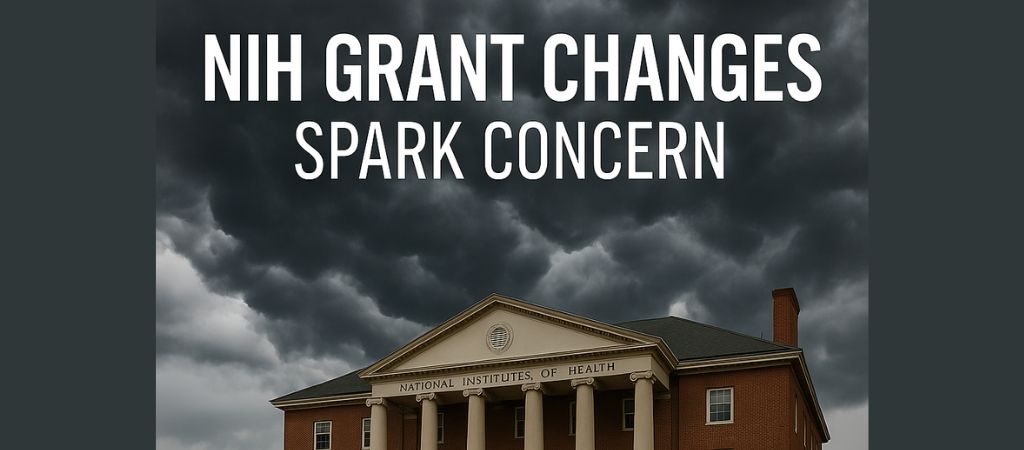
NIH Grant Changes Spark Concern Across the BioHealth Capital Region and Beyond

By News

For decades, the National Institutes of Health (NIH) has been the cornerstone of the United States’ biomedical research enterprise. But new policies introduced by the current administration, alongside a proposed 40% cut to the NIH’s FY 2026 budget, are sending shockwaves through the research community. The impacts are already visible, and deeply concerning for institutions, researchers, and innovative ecosystems across the country, including the BioHealth Capital Region (BHCR).

As first reported in Science by Jocelyn Kaiser, NIH has begun implementing a major shift in how it funds research grants: 50% of multiyear awards must now be funded in full, up front, rather than distributed year by year over the life of the grant. This policy was initiated without Congressional approval, though the 2026 budget proposal may expand this to a larger number of grants, with the percentage expected to rise to 100% by FY27. The impact of this is already reshaping funding outcomes for FY 2025.

In practice, this means that instead of spreading the cost of a three-year grant across three annual appropriations, NIH must now allocate the full amount from the current year’s budget. As a result, far fewer grants can be awarded.

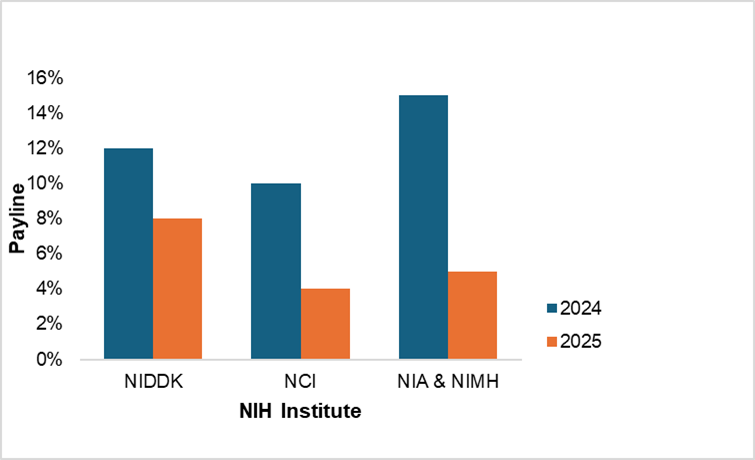
According to Kaiser’s reporting in Science, the National Cancer Institute’s (NCI) grant payline has dropped from 10% to 4%. A reduction so sharp means that many investigators will no longer consider applying. Other NIH institutes are facing similar cuts:

  • The National Institute of Diabetes and Digestive and Kidney Diseases (NIDDK) payline is projected to drop from 12% to 5–8%.
  • The National Institute on Aging (NIA) and the National Institute of Mental Health (NIMH) are each expected to fund only one-quarter to one-third as many grants as last year, reducing paylines from 15% to 4–5%.

Adding to these concerns, the NIH is reported to be conducting additional assessments of grants that have already undergone and passed scientific peer review, introducing uncertainty into a system once governed by rigor, transparency, and merit.

Full article via Science:
https://www.science.org/content/article/odds-winning-nih-grants-plummet-new-funding-policy-and-spending-delays-bite

As public policy expert Don Moynihan writes in his Substack piece, this new multi-year funding policy was imposed not by NIH leadership, but by political appointees at the Department of Health and Human Services or the White House. NIH employees are not in favor of this requirement and have been working to mitigate its damage internally. However, the rapid pace of implementation, amid an already complex fiscal year, is compounding the disruption.

Moynihan notes that the percentage of awarded applications across NIH is expected to drop by a factor of 2 to 4, leading to widespread lab closures, layoffs, and stalled medical research. The article also warns that this policy may be used to free up future NIH budgets for politically driven initiatives that bypass traditional scientific vetting.

Full article via Substack:
https://donmoynihan.substack.com/p/alert-the-trump-administration-is

The BioHealth Capital Region is home to the NIH, the FDA, over 1,800 life sciences companies, and hundreds of academic and clinical research institutions. The region’s strength, and its #3 ranking for the third consecutive year in the GEN Top 10 U.S. Biopharma Clusters list, rests in part on sustained federal support for biomedical research and commercialization.

A significant disruption in NIH grantmaking could disproportionately affect this region, where many companies and academic centers rely on NIH funding to support R&D, build talent pipelines, and bring new innovations to market.

As a public-private innovation intermediary, BioHealth Innovation, Inc. (BHI) is working closely with startups, entrepreneurs, and researchers across the region to navigate the changing landscape. BHI’s support for non-dilutive funding strategy and commercialization services has never been more critical.

Despite these challenges, well-crafted grant applications may still succeed. BioHealth Innovation’s Manager of Client Engagement, Jon Nelson, points out: “We’re certainly in the midst of one of the most difficult funding environments that the BioHealth sector has seen in a long time. However, experienced grant writers will be able to employ carefully crafted aims, thoughtful research approaches, and strategic key phrasing to continue to secure the desperately needed funding.”

Congressional leaders from both parties have expressed concern about the administration’s actions, including the possibility of rescinding unspent NIH funds at the end of the fiscal year. But time is short: the federal fiscal year ends on September 30, and decisions made in the next few weeks will shape the future of U.S. biomedical research for years to come.

BHI will continue monitoring these developments and advocating for policies that preserve America’s leadership in biomedical innovation. We urge stakeholders across the region to stay informed, connect with their Congressional representatives, and elevate the voices of scientists, innovators, and patients who depend on stable, merit-based research funding.

Please contact Jon Nelson, Ph.D., Manager of Client Engagement,

JNelson@BioHealthInnovation.org, if your organization is looking for assistance in this space.

Search

You have successfully subscribed to the newsletter

There was an error while trying to send your request. Please try again.

BioHealth Innovation will use the information you provide on this form to be in touch with you and to provide updates and marketing.