Tag

life sciences funding Archives - BioHealth Innovation

Maryland Has Grit: Tammi Thomas on TEDCO’s Role in Moving Innovation to Market on BioTalk

By BioTalk with Rich Bendis Podcast, News

In this episode of BioTalk with Rich Bendis, Tammi Thomas, President of TEDCO, joins the conversation to discuss how Maryland is helping entrepreneurs move ideas from research and concept to market.

Tammi shares how TEDCO has evolved from an early-stage funding organization into a broader partner for Maryland startups, supporting companies through capital, federal funding navigation, technical assistance, ecosystem connections, and venture development.

The conversation touches on what makes Maryland’s innovation ecosystem different, from federal labs and research universities to technical talent, founder grit, and quality of life. Tammi and Rich also discuss why helping companies stay and scale in Maryland requires more than writing a check.

Listen now via your favorite podcast platform:
Apple: https://apple.co/4cnCw30
Spotify: https://bit.ly/4clb7i3
iHeart Podcasts: https://ihr.fm/4xygovk
YouTube Music Podcasts: https://bit.ly/4wRS4Dj
Amazon Podcasts: https://amzn.to/3vpZDHI
TuneIn: https://bit.ly/3Slcx5z

Tammi highlights several TEDCO programs and initiatives, including SBIR/STTR support, the Entrepreneur Expo, the Equitech Growth Fund, the Maryland Stem Cell Research Fund, and the Maryland Makerspace Initiative.

The episode closes with a look at Maryland’s next opportunity: connecting these individual assets into a more seamless path for founders, so companies can move from feasibility to prototype, federal funding, venture capital, and commercialization without leaving the state.

Editing and post-production work for this episode was provided by The Podcast Consultant.

Tammi Thomas is President of TEDCO, Maryland’s $200M+ AUM, with another $50M being managed under a strategic partnership, $2.7B impact, economic engine for technology and life sciences companies. In this role, she serves as the primary internal leader of TEDCO, working closely with the CEO to execute priorities and translate the CEO’s vision across departments while ensuring alignment, accountability, overall performance, and company-wide commitment to transparent reporting. She is responsible for the overall strategic direction, leadership, execution and management of TEDCO’s fundraising strategies designed to broaden awareness of and expand philanthropic, corporate and investor resources for TEDCO and its various programs.

Tammi leads TEDCO’s efforts to secure additional fiscal resources from the State of Maryland, federal and philanthropic grants, and venture capital investments. Since 2020, TEDCO has increased its revenues from the State by more than 50%, has been the recipient of over $75M in federal grants, increased its AUM by over 33%, secured over $55M in foreign direct investments and created over a $500K philanthropic pipeline.

Additionally, Tammi leads TEDCO’s investor and stakeholder engagement strategy through relationship building, compelling brand storytelling, and convening high-impact events, including TEDCO’s  annual Entrepreneur Expo, which draws over 1,000 entrepreneurs, venture capitalists, legislators, and ecosystem leaders under one roof. Her leadership and knowledge are instrumental in forging relationships that will enable TEDCO to expand its reach and services, diversify funding streams, and grow the innovation ecosystem, as well as establish TEDCO as the most recognized organization in Maryland for identifying, investing in, and growing technology and life sciences-based businesses. Tammi is also a key decision maker in the organization’s investment decisions through her role on the fund allocation team, allocating over $25-30M per year.

Her experience includes executive leadership roles such as serving as the former Chief Development & Marketing Officer and now President of TEDCO, Vice President of Strategic Management at Data Solutions & Technology Inc., and Director of Business Development and Marketing at University of Maryland, Baltimore County Research Park & Business Incubator. In addition to her corporate and economic development leadership experience, Tammi’s professional expertise was sought after, to teach the next generation of communicators as an adjunct professor at Bowie State University and the University of Baltimore. She is also a frequent speaker and published thought leader on leadership, entrepreneurship, and business development.

Tammi has been recognized by her industry peers for excellence in communication, marketing and development. She has received the Maryland Economic Development Association’s Marketing award for TEDCO’s Entrepreneur Expo (2020), the Cybersecurity Association of Maryland’s 2017 Cybersecurity Industry Resource Award, the AMA Baltimore’s MX Award for Best Print Advertisement Campaign of the Year (2022 and 2023), named one of The Daily Record’s Top 100 Women in Maryland (2023 ), received a Distinguished Women Award from the Girl Scouts of Central Maryland (2024), named one of I-95 Business Magazine’s 2025 Influential Women, was chosen as a Waves of Change Impact Award honoree (2025) and most recently was selected as one of Maryland’s Top 100 Women for a second time (2026). She graduated from Leadership Maryland’s Class of 2018, completing the eight-month hands-on learning program focused on the State’s most vital social, economic and environmental issues.

She serves on the World Trade Center Institute’s CEO Council, Maryland Energy Innovation Institute Investment Committee, the Maryland Momentum Fund Advisory Board and MEDA Board of Directors, where she is currently serving as President.

Tammi earned a bachelor’s degree in marketing from Alabama State University and an MBA from the University of Baltimore.
AI in Grant Writing: Where it Helps and Where it Hurts

By EIR Insights, News

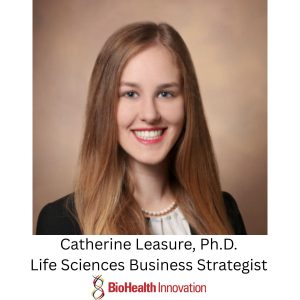
By Catherine Leasure, Ph.D., BHI Life Sciences Business Strategist – If you’ve written a grant recently, you’ve probably wondered whether AI could make the process easier. Maybe you’ve already tried it. The honest answer is that AI can help, but how much depends entirely on what you bring to it. When you know what you’re doing, it gets you to a solid draft faster. However, without a strong grasp of the process behind it, it can produce polished-sounding text that misses the mark in ways that aren’t always obvious until a reviewer or experienced grant writer points them out.

Where AI Earns Its Keep

The tasks where AI performs best are the ones that are time-consuming but relatively mechanical. Generating a document outline that accounts for both grant requirements and your specific project content is a good example. What might take an hour of cross-referencing a funding opportunity announcement can be done in minutes with the right prompt. From there, AI can help turn that outline into a working first draft and translate dense technical language into plain descriptions for non-specialist reviewers, which is particularly useful when generating ancillary documents like abstracts or project summaries that need to be accessible to a broad audience.

AI also shines in the later stages of drafting. Grant applications are long documents, and inconsistencies are easy to overlook when you’ve been working on the proposal for weeks or months. Terminology that shifts between sections that were written by different people, early claims that aren’t fully supported later in the document, and overly wordy sentences are all the kinds of issues that AI excels at catching and fixing. It can also serve as a compliance checker, making sure required sections are present and that the structure of your application matches what the solicitation requires.

None of this replaces the thinking that goes into a competitive application. But it does free up time and mental energy for the parts that require it.

Where AI Falls Short

The same confidence that makes AI useful in the drafting process can work against you when the content and strategy require nuance. AI can misrepresent novel technologies, fabricate citations, or produce technically plausible descriptions that are subtly wrong (this is called hallucinating). For early-stage companies with innovative science, this is a real risk. AI can only work with what you give it. If you’re not providing detailed, accurate information about your technology and approach, it will fill in the gaps on its own, and not always correctly. You need someone who actually understands the technology both guiding the prompts and reviewing anything AI generates before it goes into your final draft.

Beyond accuracy, there’s a layer of strategic knowledge that AI doesn’t have access to. It can’t tell you how a program officer has been framing their priorities in recent conversations, what a review panel tends to weigh most heavily, or whether your project is actually a good fit for a particular solicitation before you invest time writing your proposal. That kind of information comes from reaching out to and meeting with program officers before you submit. These conversations can reshape an application in ways that no AI tool can replicate.

Then there’s the writing itself. Even the best prompts can produce text that experienced reviewers recognize immediately: sentence structures like “it’s not X, it’s Y,” excessive adjectives, and the overuse of certain punctuation are all patterns that show up repeatedly in AI-generated text. Beyond the stylistic tells, AI tends toward a kind of confident vagueness that sounds thorough but doesn’t actually say much. In competitive grant programs, that kind of generic writing loses. If AI contributes to any part of your draft, it’s the grant writer’s job to make sure the final product sounds like it was written by a real person. Reviewers who are engaged with your writing are more likely to be engaged with your science.

Finally, using AI to write your grant poses a potential confidentiality risk that often goes overlooked. When you paste proprietary information about your technology into a public AI tool, that content may be used to train the model, and there is no guarantee it will stay private. Details about your innovation could potentially surface in someone else’s results! Treat any public AI tool the way you would any other unsecured channel: don’t put anything in that you wouldn’t be comfortable sharing publicly.

Agency Guidance on AI Use

Some funding agencies have begun addressing AI use in applications directly. NIH, for example, recently issued guidance stating that applications that are substantially developed by AI will not be considered original ideas of the applicant, and that the NIH employs AI detection tools to identify AI-generated content (NOT-OD-25-132). Applications found to be in violation post-award can face serious consequences, including cost disallowance, grant suspension, or termination. The NSF has taken a slightly more lenient approach, requesting that proposers disclose whether AI tools were used when preparing an application. The NIH and the NSF are not alone in scrutinizing AI use, and it is reasonable to expect other agencies to follow suit as AI use becomes more widespread.

The Bottom Line

AI is a useful tool in the grant writing process, but it works best as a starting point, not a final product. The applications that score well aren’t necessarily the ones with the smoothest prose, they’re the ones that demonstrate a clear understanding of the funding landscape, make a compelling scientific case, and show reviewers that the team behind the project knows what they’re doing. That requires expertise that no prompt can substitute for.

Used effectively, AI can get you to a better draft faster. But knowing how to use it thoughtfully, and knowing when not to rely on it, is itself a skill.

Work with Us

At BHI, we work with clients from the earliest stages of identifying the right funding opportunity through grant submission, including helping determine where AI can speed up the process and where it needs to be set aside in favor of human expertise. Our grant writers have supported over 200 applications, helping clients secure $66M in non-dilutive funding. If you’re working on a grant application and want to make sure you’re using every tool available without sacrificing the quality of your submission, we’d love to talk.

Search

You have successfully subscribed to the newsletter

There was an error while trying to send your request. Please try again.

BioHealth Innovation will use the information you provide on this form to be in touch with you and to provide updates and marketing.