
From September 23–25, more than 2,000 leaders from industry, government, academia, investment, and research gathered in College Park, Maryland, for the 2026 Quantum World Congress. Held at The Hotel at the University of Maryland, the three-day event brought the global quantum community directly into one of the country’s most concentrated quantum ecosystems.

The University of Maryland served as the Congress’s Lead Academic Partner, while platinum sponsors included Atom Computing, Classiq, D-Wave, IBM, Infleqtion, IonQ, Microsoft, and Quantinuum. For Maryland, the location was meaningful. College Park and the surrounding BioHealth Capital Region are home to major quantum research programs, federal assets, emerging companies, and industry leaders including IonQ, creating a foundation few regions can match.
For BioHealth Innovation, Inc. (BHI), the Congress also reinforced an opportunity that extends beyond quantum computing itself: bringing Maryland’s strengths in quantum together with one of the region’s other major competitive advantages, life sciences.
BHI President and CEO Rich Bendis participated in a Maryland-Canada roundtable that included Maryland Secretary of Commerce Harry Coker, Canadian Deputy Ambassador to the United States Nadia Theodore, IonQ leaders, researchers, commercialization leaders, and other participants from the U.S. and Canada. The Congress also featured IonQ Chairman and CEO Niccolo de Masi, underscoring IonQ’s central role in College Park’s quantum ecosystem. Bendis also serves on Maryland’s Life Sciences Advisory Board and is involved in the LSAB Ad-Hoc Quantum Commercialization Committee, which is examining how Maryland can translate its quantum assets into commercial life science opportunities.
“We have a goal to make Maryland the BioHealth Quantum Commercialization Capital of the World,” said Bendis.
That goal is closely aligned with BHI’s broader work to help define how the BioHealth Capital Region can move from research strength to companies, products, capital, jobs, and impact. BHI has been working with partners to frame the region’s quantum-biohealth opportunity around areas such as quantum sensing, diagnostics and early detection, imaging, drug discovery, computational biology, AI-enabled life sciences, federal health missions, and commercialization pathways.
The discussions at Quantum World Congress highlighted both the scale of Maryland’s opportunity and the growing competition surrounding it. States including Tennessee, Ohio, and Florida are developing quantum strategies and pursuing partnerships with major industry participants. Countries and international regions are doing the same. Companies such as IonQ are increasingly working across multiple states and markets as governments compete for investment, talent, research partnerships, and future commercial activity.
Maryland and the BioHealth Capital Region already possess many of the pieces needed to compete. UMD has decades of quantum research experience and more than 350 researchers working across quantum-related disciplines. College Park is home to IonQ and Quantum Catalyzer, or Q-Cat, which was created to help translate promising quantum technologies into new companies. The region also benefits from proximity to NIH, FDA, NIST, federal laboratories, defense and national security assets, major research universities, investors, and one of the nation’s strongest life science clusters.
Capital of Quantum adds another important layer. The five-year, $1 billion public-private initiative is helping organize the region’s quantum ecosystem around research, commercialization, workforce development, federal collaboration, infrastructure, and industry growth. For the BioHealth Capital Region, the question is how to connect that quantum momentum to biohealth use cases where the region can lead.
That is where commercialization becomes essential. Research strength alone will not determine which regions win. The winners will be the places that can connect science, intellectual property, experienced entrepreneurs, early-stage capital, industry demand, federal funding, and market strategy.
Quantum Catalyzer provides one early example of what this can look like. Based in College Park’s Discovery District, Q-Cat demonstrates how quantum sensing technologies can be productized, how IP can be created, how companies can be formed, and how industry and government demand can be connected to emerging quantum capabilities.
Discussions during the Congress pointed to opportunities in quantum sensing, regenerative medicine, computational biology, drug development, imaging, diagnostics, and other life science applications. They also underscored the need for commercialization expertise, early-stage capital, industry partnerships, and experienced talent capable of translating quantum research into products and companies.
International collaboration could play an important role as well. The Maryland-Canada roundtable identified potential areas where complementary life science and quantum capabilities could be brought together. Existing relationships between IonQ and Canadian organizations such as CCRM provide one model for exploring how quantum technologies could support new approaches in regenerative medicine and other areas.
The message coming out of Quantum World Congress was encouraging, but it also carried urgency.
Maryland and the BioHealth Capital Region have the research, companies, talent, federal connections, and life science infrastructure to establish a differentiated global position at the intersection of quantum and biohealth. Other regions are moving quickly, however, and leadership will depend on turning those assets into a coordinated commercialization strategy.
The opportunity is no longer theoretical. The next step is building the strategy, partnerships, funding mechanisms, and commercialization infrastructure needed to make this region the place where quantum-enabled life science discoveries move from research to market.
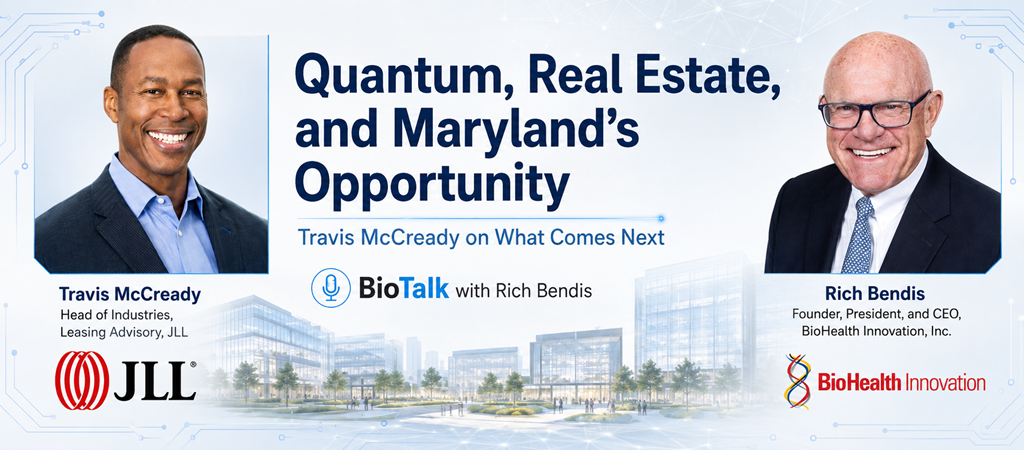
 In this episode of BioTalk with Rich Bendis, Travis McCready, Head of Industries, Leasing Advisory at JLL, joins the conversation to discuss quantum computing, why real estate professionals are paying attention, and what this emerging technology could mean for regions like the BioHealth Capital Region.