Tag

Biohealth Capital Region Archives - BioHealth Innovation

BioHealth Innovation Welcomes Dr. Nilay Shah to Board of Directors

By News

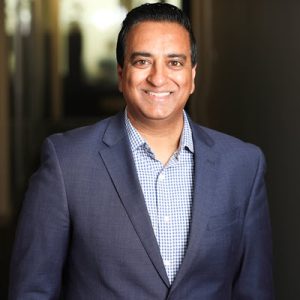
BioHealth Innovation, Inc. (BHI) is pleased to announce the appointment of Dr. Nilay Shah to its Board of Directors. A physician–executive with more than 20 years of experience in global clinical development and commercial strategy, Dr. Shah brings deep expertise in advancing innovative therapies from early development through regulatory approval and market entry.

Dr. Shah currently serves as Senior Vice President and Global Head of Ophthalmology at Emmes, where he leads the company’s fastest-growing therapeutic division and serves on the Executive Management Committee. Over the course of his tenure, he has helped scale the organization into a global CRO serving biotech innovators across North America, Europe, Latin America, and Asia. His experience spans Phase I through Phase III trials, FDA and EMA engagement, pharmacovigilance, and strategic alliances with emerging and growth-stage life sciences companies.

Throughout his career, Dr. Shah has served as a Medical Monitor for various studies and also has directed complex, multi-national clinical programs, including global trials supporting market authorization of novel biologics and the first autonomous AI-based diagnostic system approved by the FDA for the detection of diabetic retinopathy. He has also built and led high-performing cross-functional teams, strengthened commercial strategy, and partnered closely with venture-backed companies navigating regulatory and operational milestones.

Beyond his executive leadership, Dr. Shah has played an active role in Maryland’s innovation ecosystem. He serves as an advisor and reviewer for multiple TEDCO venture programs and is a Board Member of the Baltimore Innovation Initiative, where he supports early-stage founders in clinical strategy, regulatory planning, and commercialization.

“Nilay brings a rare combination of physician insight, global clinical operations leadership, and commercial acumen,” said BHI President and CEO, Rich Bendis. “He understands what it takes to move a therapy from concept to approval, and he has done it at scale. As we continue to support entrepreneurs and growing companies across the BioHealth Capital Region and beyond, his experience will strengthen our ability to guide companies through critical development and regulatory inflection points.”

“I am honored to join the Board of BioHealth Innovation at a pivotal time for the BioHealth Capital Region,” said Nilay C. Shah, MBBS (MD), Senior Vice President and Global Head of Ophthalmology at Emmes. “We are witnessing a powerful convergence of breakthrough science, artificial intelligence, and precision medicine, but innovation only matters if it translates into approved and accessible therapies. Throughout my career in global clinical development, I have seen how early strategic guidance and disciplined execution accelerate that journey. BioHealth Innovation uniquely bridges scientific innovation and commercialization, and I look forward to supporting entrepreneurs as they navigate critical regulatory and development milestones to bring transformative therapies to patients faster.”

Dr. Shah’s appointment reflects BHI’s continued focus on assembling a board with hands-on experience in therapeutic development, regulatory strategy, venture engagement, and global operations. His perspective will support the organization’s mission to accelerate commercialization, mentor emerging companies, and expand the region’s leadership in biohealth innovation.


Nearly 200 Episodes In. The BioTalk With Rich Bendis Podcast Wants Your Guest Suggestions

By News

BioTalk with Rich Bendis wants to hear from its audience about the voices that deserve the mic. A new guest submission form is now live at https://bit.ly/BioTalkGuest, making it easy for listeners, partners, and community members to recommend leaders shaping the future of biohealth.

BioTalk is a long-running podcast hosted by Rich Bendis that focuses on the real stories behind innovation in the life sciences. The show features open, unscripted conversations with founders, executives, scientists, investors, policymakers, and ecosystem builders who are moving ideas from lab to market. Topics range from company building and commercialization to policy, workforce, capital, and collaboration. The goal is clarity and perspective, grounded in experience.

With nearly 200 episodes, BioTalk has built a strong following across the industry. Many conversations highlight leaders and initiatives connected to the BioHealth Capital Region, while others bring in national and global voices whose work influences the region and the broader biohealth landscape. Episodes are designed to be accessible and relevant, offering insights that listeners can actually use.

Now, BioTalk is turning to its audience. Who should be featured next. Which voices are missing. Who is doing work that more people should hear about. If you know a founder, researcher, investor, policymaker, or industry leader with a compelling story or perspective, submit a recommendation at https://bit.ly/BioTalkGuest. The podcast wants to reflect what its listeners care about and continue spotlighting the people driving the biohealth industry forward.

Thanking Jarrod Borkat and Rachel Rath for Their Service on the BioHealth Innovation Board

By News

BioHealth Innovation extends its sincere thanks to Jarrod Borkat, Chief Commercial and Strategy Officer at On Demand Pharmaceuticals, and Rachel Rath, Head of JLABS @ Washington DC, for their dedicated service on the Board of Directors.
Throughout their tenure, both leaders brought a steady, thoughtful presence to the board and helped strengthen the organization’s role within the BioHealth Capital Region. Their perspectives, grounded in deep industry experience and regional engagement, supported informed decision-making and reinforced a shared commitment to advancing innovation across the ecosystem.

Jarrod Borkat’s career spans senior commercial, strategy, and partnership roles across the biopharmaceutical sector. His experience building large-scale collaborations among industry, academia, and government brought practical insight to board discussions, particularly around commercialization pathways and cross-sector engagement. His long-standing involvement in the region reflects a consistent belief in collaboration as a foundation for sustainable growth.

During his time with MedImmune and AstraZeneca, Jarrod played a key role in advancing the BioHealth Capital Region (BHCR) brand and strengthening its national profile. He was also a strong advocate for BioHealth Innovation expanding its footprint into Washington, DC, and Virginia, helping foster a more integrated regional ecosystem. In addition, he served on the Board’s Executive Committee, where his strategic perspective supported organizational growth and transition.

Rachel Rath provided a complementary lens shaped by her leadership at one of the region’s most active innovation platforms. Her work evaluating and accelerating early-stage companies, along with prior experience supporting national health security and clinical research initiatives, informed the board’s understanding of emerging technologies and the needs of founders navigating complex development environments.

“Jarrod and Rachel have been exceptional board members and trusted partners,” said Rich Bendis, Founder, President, and CEO of BioHealth Innovation. “Their leadership, insight, and commitment to the BioHealth Capital Region have made a lasting impact. We are grateful for their service and for the time and expertise they so generously shared.”

BioHealth Innovation wishes both leaders continued success and looks forward to their ongoing contributions to the region’s innovation community.

Building a Life Sciences Innovation District in Prince William County on BioTalk

By BioTalk with Rich Bendis Podcast, News

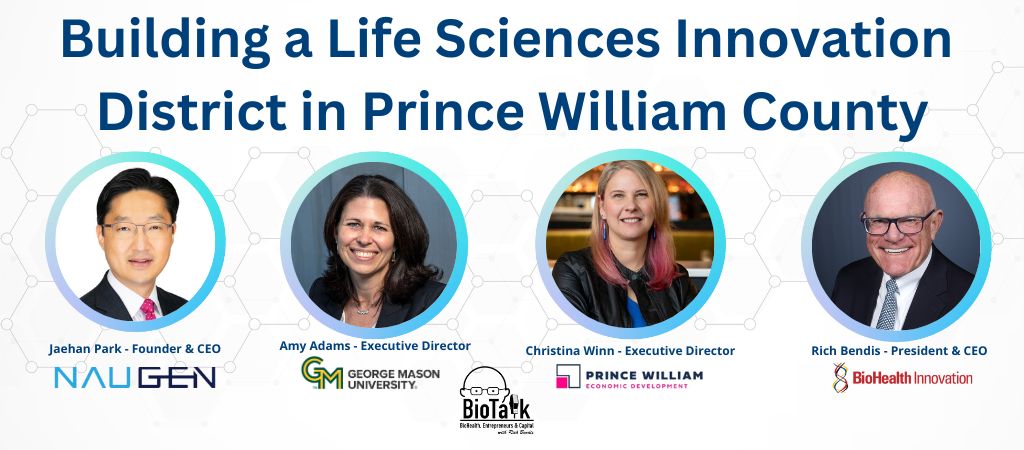
This episode of the BioTalk with Rich Bendis Podcast brings together leaders from industry, academia, and economic development to unpack the vision behind a new life sciences Innovation District anchored in Prince William County. With introductions to NAUGEN, George Mason University’s Institute for Biohealth Innovation, and the Prince William County Department of Economic Development, setting the stage for how each organization contributes to the district’s foundation. The guests discuss the life science assets, research strengths, and translational capabilities that define the district and explain why it is well-positioned to support biotechnology and advanced R&D companies.

The podcast explores how the partnership between Prince William County, George Mason University, and the City of Manassas came together, outlining the distinct roles each plays in advancing a shared strategy. The episode also introduces the NISA program, detailing how it supports companies seeking a soft-landing pathway into the district, the types of organizations best suited for the program, and the facilities, talent, and collaborative resources participants can access both immediately and over time.

Listen now via your favorite podcast platform:
Apple: https://apple.co/4p94Dqe
Spotify: https://bit.ly/3Y7dJZw
iHeart Podcasts: https://ihr.fm/3KLV7v4
Amazon Music Podcasts: https://amzn.to/4pajS1P
YouTube Music Podcasts: https://bit.ly/4phRV8I
TuneIn: https://bit.ly/44GoG7Y

Editing and post-production work for this episode was provided by The Podcast Consultant (https://thepodcastconsultant.com).

Jaehan Park is Founder and CEO of NAUGEN, a global innovation accelerator advancing novel technologies across life sciences and deep tech. With more than 25 years of experience in strategy and business development, he has led collaborations spanning cancer immunotherapy, vaccines, and biologics with global pharmaceutical companies and academic institutions. He leads the NISA Program in partnership with George Mason University and serves as a Mentor-in-Residence at KIC DC, supporting international startups entering U.S. markets.

Amy Adams is Executive Director of George Mason University’s Institute for Biohealth Innovation, where she advances biohealth research and innovation across more than 300 faculty and thousands of students. Her work focuses on partnerships, shared research infrastructure, and building hubs that connect academia with industry. She is co-leading the development of the Innovation District anchored at Mason’s SciTech campus and serves on the boards of BioHealth Innovation and the Association of University Research Parks.

Christina Winn leads the Prince William County Department of Economic Development, guiding investment, business growth, and redevelopment efforts across one of Virginia’s largest counties. She is overseeing the development of a research-driven Innovation District in partnership with George Mason University and the City of Manassas, supported by a GO Virginia grant. Her career includes leading large-scale economic development initiatives that have driven significant capital investment, job creation, and national visibility for the region.

Inside FNIH: Dr. Stacey Adam on Smarter, Human-Based Research on BioTalk

By BioTalk with Rich Bendis Podcast, News

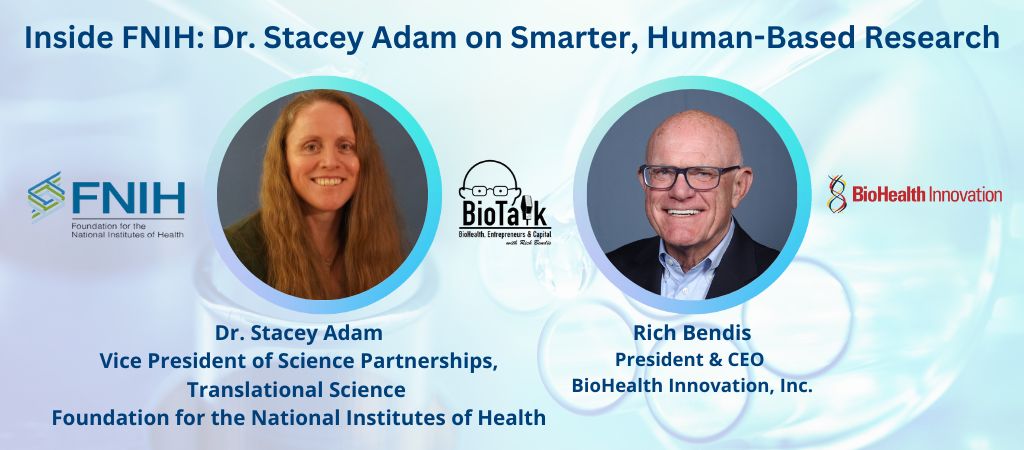
In this episode of BioTalk, Rich Bendis welcomes Dr. Stacey Adam, Vice President of Science Partnerships, Translational Science at the Foundation for the National Institutes of Health (FNIH), to discuss how public-private partnerships are advancing scientific innovation. Dr. Adam introduces the mission of FNIH and its unique role in bridging government, industry, and academia to accelerate biomedical progress. She highlights the Validation and Qualification Network (VQN), a new initiative working to overcome barriers to the adoption of New Approach Methodologies (NAMs) and explains how cross-sector collaboration is driving its early success. The conversation explores the long-term vision of the VQN, the global perspectives shaping its approach, and how it fits into the broader NIH Complement-ARIE initiative. Dr. Adam also reflects on the significance of being headquartered in the BioHealth Capital Region and how it supports the Foundation’s mission.

Listen now via your favorite podcast platform:
Apple – https://apple.co/3UngVhK
Spotify – https://bit.ly/411Mdym
YouTube Podcasts – https://bit.ly/4m3tY3Y
iHeart – https://ihr.fm/4locw9o
Amazon Podcast – https://amzn.to/3JaSO3l

Editing and post-production work for this episode was provided by The Podcast Consultant.

Guest Bio
Dr. Stacey Adam is Vice President of Science Partnerships at the Foundation for the NIH (FNIH), where she leads major public-private partnerships including the RECOVER-Treating Long COVID initiative, multiple Biomarkers Consortium projects, the Accelerating Medicines Partnerships (AMPs), and the Lung-MAP clinical trial. She also leads efforts to design new public-private partnerships focused on pediatric medical devices, cancer systems biology, and the advancement of New Approach Methodologies (NAMs) through the Validation and Qualification Network. Previously, Dr. Adam worked at Deloitte Consulting and completed a postdoctoral fellowship at Stanford University School of Medicine. She holds a PhD in Pharmacology with a Certificate in Mammalian Toxicology from Duke University.

NIH Grant Changes Spark Concern Across the BioHealth Capital Region and Beyond

By News

For decades, the National Institutes of Health (NIH) has been the cornerstone of the United States’ biomedical research enterprise. But new policies introduced by the current administration, alongside a proposed 40% cut to the NIH’s FY 2026 budget, are sending shockwaves through the research community. The impacts are already visible, and deeply concerning for institutions, researchers, and innovative ecosystems across the country, including the BioHealth Capital Region (BHCR).

As first reported in Science by Jocelyn Kaiser, NIH has begun implementing a major shift in how it funds research grants: 50% of multiyear awards must now be funded in full, up front, rather than distributed year by year over the life of the grant. This policy was initiated without Congressional approval, though the 2026 budget proposal may expand this to a larger number of grants, with the percentage expected to rise to 100% by FY27. The impact of this is already reshaping funding outcomes for FY 2025.

In practice, this means that instead of spreading the cost of a three-year grant across three annual appropriations, NIH must now allocate the full amount from the current year’s budget. As a result, far fewer grants can be awarded.

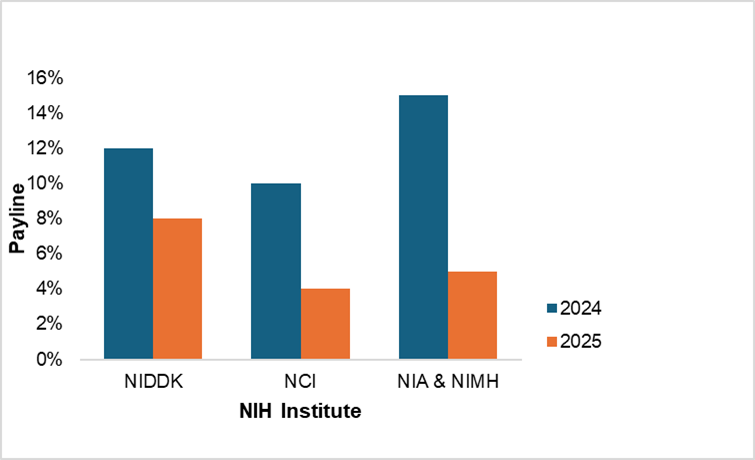
According to Kaiser’s reporting in Science, the National Cancer Institute’s (NCI) grant payline has dropped from 10% to 4%. A reduction so sharp means that many investigators will no longer consider applying. Other NIH institutes are facing similar cuts:

  • The National Institute of Diabetes and Digestive and Kidney Diseases (NIDDK) payline is projected to drop from 12% to 5–8%.
  • The National Institute on Aging (NIA) and the National Institute of Mental Health (NIMH) are each expected to fund only one-quarter to one-third as many grants as last year, reducing paylines from 15% to 4–5%.

Adding to these concerns, the NIH is reported to be conducting additional assessments of grants that have already undergone and passed scientific peer review, introducing uncertainty into a system once governed by rigor, transparency, and merit.

Full article via Science:
https://www.science.org/content/article/odds-winning-nih-grants-plummet-new-funding-policy-and-spending-delays-bite

As public policy expert Don Moynihan writes in his Substack piece, this new multi-year funding policy was imposed not by NIH leadership, but by political appointees at the Department of Health and Human Services or the White House. NIH employees are not in favor of this requirement and have been working to mitigate its damage internally. However, the rapid pace of implementation, amid an already complex fiscal year, is compounding the disruption.

Moynihan notes that the percentage of awarded applications across NIH is expected to drop by a factor of 2 to 4, leading to widespread lab closures, layoffs, and stalled medical research. The article also warns that this policy may be used to free up future NIH budgets for politically driven initiatives that bypass traditional scientific vetting.

Full article via Substack:
https://donmoynihan.substack.com/p/alert-the-trump-administration-is

The BioHealth Capital Region is home to the NIH, the FDA, over 1,800 life sciences companies, and hundreds of academic and clinical research institutions. The region’s strength, and its #3 ranking for the third consecutive year in the GEN Top 10 U.S. Biopharma Clusters list, rests in part on sustained federal support for biomedical research and commercialization.

A significant disruption in NIH grantmaking could disproportionately affect this region, where many companies and academic centers rely on NIH funding to support R&D, build talent pipelines, and bring new innovations to market.

As a public-private innovation intermediary, BioHealth Innovation, Inc. (BHI) is working closely with startups, entrepreneurs, and researchers across the region to navigate the changing landscape. BHI’s support for non-dilutive funding strategy and commercialization services has never been more critical.

Despite these challenges, well-crafted grant applications may still succeed. BioHealth Innovation’s Manager of Client Engagement, Jon Nelson, points out: “We’re certainly in the midst of one of the most difficult funding environments that the BioHealth sector has seen in a long time. However, experienced grant writers will be able to employ carefully crafted aims, thoughtful research approaches, and strategic key phrasing to continue to secure the desperately needed funding.”

Congressional leaders from both parties have expressed concern about the administration’s actions, including the possibility of rescinding unspent NIH funds at the end of the fiscal year. But time is short: the federal fiscal year ends on September 30, and decisions made in the next few weeks will shape the future of U.S. biomedical research for years to come.

BHI will continue monitoring these developments and advocating for policies that preserve America’s leadership in biomedical innovation. We urge stakeholders across the region to stay informed, connect with their Congressional representatives, and elevate the voices of scientists, innovators, and patients who depend on stable, merit-based research funding.

Please contact Jon Nelson, Ph.D., Manager of Client Engagement,

JNelson@BioHealthInnovation.org, if your organization is looking for assistance in this space.

Just Over 6 Weeks Away: Get Ready for the 11th Annual BioHealth Capital Region Forum

By News

Planning for the 2025 BioHealth Capital Region Forum is in full swing, and with just over six weeks to go, the agenda is shaping up to be one of the strongest yet.
This year’s theme, “Where Human and Artificial Intelligence Converge in the BioHealth Industry,” will be reflected across two days of keynotes, panels, and discussions that bring together leaders from industry, government, academia, and the investment community.

Returning favorites include Alex Philippidis from Genetic Engineering & Biotechnology News with his much-anticipated GEN Top 10 BioCluster Update, and JLL’s latest BioHealth Capital Region market analysis.

This year’s panels will dive into some of the most critical and timely topics across the ecosystem, from the evolving federal funding environment and national S&T priorities to emerging AI applications in biotech, the intersection of quantum technologies and healthcare, university-driven innovation, the role of philanthropy in R&D, and the future of domestic biomanufacturing. We’ll also host fireside chats, investment insights, and conversations with leading voices helping to shape the future of the region.

Speakers and panelists will be announced in the coming weeks.

Now in its 11th year, the Forum continues to be the cornerstone of BHCR Week, offering a platform for strategic dialogue, new collaborations, and regional visibility. Whether you’re a startup founder, policymaker, investor, or part of a major institution, this is your opportunity to join hundreds of decision-makers for two days of in-person insight and connection.

The Forum is free to attend thanks to our generous sponsors.
Register now and be part of the conversation: https://bit.ly/BHCRWeek2025

Want your organization recognized on this national stage? Sponsorship opportunities are still available — contact Rich Bendis (rbendis@biohealthinnovation.org) or Andy Eckert (aeckert@biohealthinnovation.org) to learn more.

[/vc_column_text][/vc_column][/vc_row]

TDR: BioHealth Capital Region Forum: A recap of innovation and collaboration

By Uncategorized

TDR: BioHealth Capital Region Forum: A recap of innovation and collaboration

The 2024 BioHealth Capital Region Forum (BHCRF) once again solidified its position as the premier gathering for the life sciences industry in the region. Marking the tenth year of the impactful event,  hundreds of industry leaders, government officials, academic researchers and investors were brought together to discuss the latest trends, challenges and opportunities in the field.

A well-oiled collaboration

It takes a village to plan and manage a forum. The BioHealth Capital Region (BHCR) Conference planning committee collaborated with sponsors including TEDCO and event management from Taylor Made Experience to ensure an organized, engaging event.

TEDCO’s chief investment officer Jack Miner praised the BioHealth region and forum, noting “This region is probably the most functional in terms of sharing resources, not diluting each other’s efforts…the entrepreneurs really benefit a lot from the collaboration that’s been created in this region, and that’s really unique.”

Richard Bendis, founder, president, and CEO of BHI agreed, stating “We’re proud to have TEDCO as a collaborator who is funding a lot of the early-stage life science companies in the state of Maryland that actually are participants in this event.”

Regional collaboration, investment, and funding

The forum demonstrated a growing emphasis on regional collaboration, welcoming Maryland Governor Wes Moore and Virginia Governor Glenn Younkin, setting the tone for collaborative discussions in the DC, Maryland and Virginia (DMV) region.

Kicking off the event, Governor Moore highlighted Maryland’s significant investments in the sector, including 54,000 jobs, 3,600 labs and offices and the largest concentration of PhDs and MDs in the country. Governor Youngkin complimented this dedication by emphasizing Virginia’s commitment to fostering research and development through investments of $110 million.

Over the course of different panels throughout the event allowed investors and entrepreneurs to discuss challenges and opportunities associated with the current funding landscape, strategies for attracting capital, and the role of government funding programs.

In a regional panel focused on SSBCI funding, Miner noted that he along with investment professionals from across the region including Nick Duafala of KStreet Ventures in Washington, D.C. and Tom Weithman of Virginia Innovation Partnership Corporation (VIPC), continue their commitment to “focus on the founder and the company’s best interest first and the geographic location second.”

Click here to continue reading.

Search

You have successfully subscribed to the newsletter

There was an error while trying to send your request. Please try again.

BioHealth Innovation will use the information you provide on this form to be in touch with you and to provide updates and marketing.