

With both Maryland and Virginia donating land and financing construction of new federal buildings, a hundred square mile District of Columbia (originally called Territory of Columbia) was surveyed.
With both Maryland and Virginia donating land and financing construction of new federal buildings, a hundred square mile District of Columbia (originally called Territory of Columbia) was surveyed.

As an entrepreneur, I spent over three years in two different startup incubators – Brazil’s Genesis Institute, part of PUC-Rio’s university, and Maryland’s Rockville Innovation Center, run by Montgomery County’s Economic Development Department. As mentor, I have also had the opportunity to coach several incubated companies, from incubators like 1776 and beyond. I could experience firsthand the benefits of business incubation, which can be significant for early-stage entrepreneurs.

Max Becton and Fairleigh Dickinson were two travelling salesmen when they met through an act of kindness in a Texas railroad station in 1897. The friendship that resulted formed the basis of a partnership that built Becton-Dickinson into a global medical technology company based in Bergen County. A story in 201 Magazine recounts the history of how the company got started.

For more than a decade, Indianapolis-based Lumina Foundation has been making grants to organizations that support its mission of increasing the number of adults obtaining postsecondary credentials.
That’s the typical playbook for private foundations—contribute to other not-for-profits that are trying to make a difference. But over the past year, Lumina has aggressively moved in a more novel direction, funneling more of its $1.2 billion endowment into venture capital. Instead of just handing out grants, it’s taking ownership stakes in for-profit businesses, mainly education-tech startups.

University of Maryland (UM) Ventures announced today that the University of Maryland, Baltimore (UMB) has granted worldwide, exclusive licensing rights for a new vaccine technology to Serenta Biotechnology, LLC, a Gaithersburg, MD-based startup. The license is based on technology co-owned by UMB and Northern Arizona University and is the basis for a multivalent vaccine against infections caused by Staphylococcus aureus, a bacterial strain often resistant to antibiotics.

Are you an NIH-funded investigator focused on medical device innovations? NIH recently announced the availability of administrative supplements to parent awards for a number of different activity codes with participation by four ICs (see lists below). Both SBIR/STTR awardees as well as recipients of a number of different research grants are eligible.

Maryland Technology Development Corp. is offering $300,000 to the person or organization that comes up with the best idea for how to support and grow technology companies in the state.
The Concept to Clinic: Commercializing Innovation (C3i) Program is designed to provide NIH-funded medical device innovators with an entrepreneurship training program to include specialized business frameworks and essential tools for successful translation of biomedical technologies from lab (concept) to market (clinic). The curriculum and customized mentoring provided by the program are intended to guide investigators in assessing the commercial viability and potential business opportunity for their innovation.

We are pleased to report that 20/20 placed first place among 21 pre-selected entrepreneurial contestants this month at the U.S. China Innovation & Investment Summit InnoSTARS competition in Houston, Texas: http://www.uschinainnovation.org/innostars/ . As a result, we have won an all-expenses paid trip to China to meet with and pitch to investors in that country as part of the Final Stage of the contest. The contest involved a 7-minute pitch by the CEO of 20/20 followed by Q&A before a panel of judges comprising Chinese and American VCs and business executives.
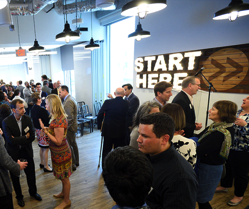
On April 26, hundreds of people came to East Baltimore for the grand opening of FastForward 1812. The event, billed as a celebration of a new physical space to support innovation, was just as much a celebration of the innovation hub’s promise to impact the future of Johns Hopkins, the city of Baltimore and people around the world by helping bring life-changing technologies to market.
“[This space is] a physical manifestation of our commitment to bringing together the necessary ingredients of innovation,” Johns Hopkins University President Ronald J. Daniels said during the celebration’s opening remarks.