

Australian scientists have developed a simple blood test that they claim can diagnose cancer in mere minutes by identifying a unique DNA signature present in all types of the disease.
Australian scientists have developed a simple blood test that they claim can diagnose cancer in mere minutes by identifying a unique DNA signature present in all types of the disease.

The Institute of Human Virology (IHV) at the University of Maryland School of Medicine (UMSOM) announced today the discovery that DnaK, a protein of the bacterium mycoplasma, interferes with the mycoplasma-infected cell’s ability to respond to and repair DNA damage, a known origin of cancer.
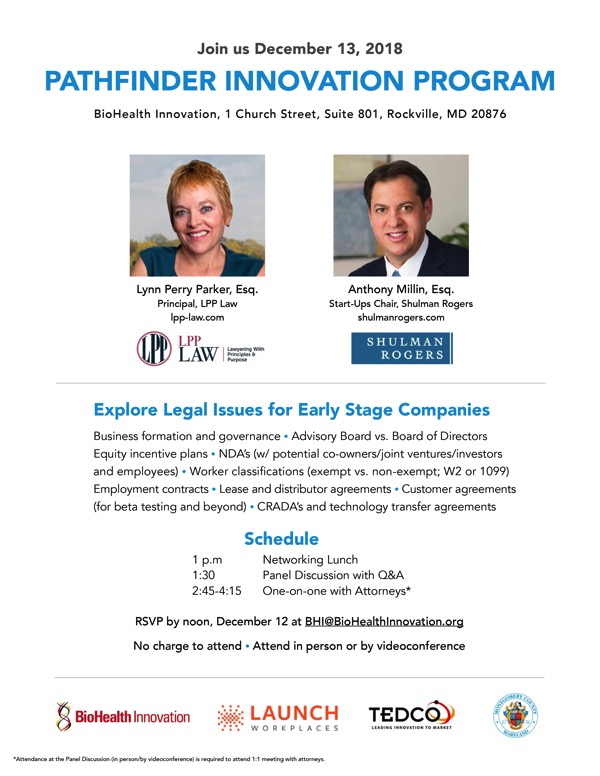
Explore Legal Issues for Early Stage Companies
Business formation and governance • Advisory Board vs. Board of Directors Equity incentive plans • NDA’s (w/ potential co-owners/joint ventures/investors and employees) • Worker classifications (exempt vs. non-exempt; W2 or 1099) Employment contracts • Lease and distributor agreements • Customer agreements (for beta testing and beyond) • CRADA’s and technology transfer agreements
Schedule
1 p.m – Networking Lunch
1:30 – Panel Discussion with Q&A
2:45-4:15 – One-on-one with Attorneys*
RSVP by noon, December 12 at BHI@BioHealthInnovation.org
No charge to attend • Attend in person or by videoconference
BioHealth Innovation, 1 Church Street, Suite 801, Rockville, MD 20876

Creatv MicroTech, Inc. (Creatv) has received notice from the Japanese Patent Office that its patent covering numerous clinical applications for the detection of cancer associated macrophage-like cells (CAMLs) in cancer patient blood samples has been issued. Clinical applications of the CAML biomarker include cancer screening, various cancer diagnostics, and early detection of disease recurrence. Approved claims cover all solid tumors. Similar patents have been issued in Europe and Australia.

The FDA has selected eight medtech companies to develop devices to help reduce the country’s opioid abuse crisis.

On November 29, 2018 at Martin’s West, RMI’s 2018 Champions of Maryland Manufacturing Awards ceremony drew over 600 stakeholders from around the State. The evening awards program touched on the themes of togetherness and family as we celebrated a variety of different leaders from young students to business executives.

RoosterBio Inc, a leading supplier of human Mesenchymal Stem/Stromal Cell (hMSC) working cell banks and hMSC-specific bioprocess systems, announces today it has submitted a U.S. Food and Drug Administration (FDA) Type II Master File (MF) for its CliniControl™ line of cGMP hMSC working cell banks. This MF complements the MF for the CliniControl RoosterNourish™-MSC-CC bioprocess media that was filed in 2017. The MFs contain confidential information on the products including their chemistry, manufacture, and controls. This enables RoosterBio to protect proprietary product information yet allows the FDA to review the information in support of an investigator’s submission. Upon request, RoosterBio will grant a customer authorization to cross reference the stated MF(s) to support their own regulatory filing, such as an Investigational New Drug (IND) application to the FDA. INDs are filed with the FDA prior to beginning clinical evaluation of new therapeutic products in human subjects.

New Enterprise Associates has completed a roughly $1 billion secondary sale of 26 portfolio companies in a deal designed to bring early liquidity to limited partners in four of its funds. T

The recent shocking reports about a human genome editing experiment have led to increased murmurings about the potential pitfalls of improved access to molecular technologies. Sharing speeds science. That’s been the driving concept behind Addgene since its founding. Nowhere has this proved more prescient than in the acceleration of basic research using CRISPR-Cas9 genome editing tools. It would be a tremendous loss of efficiency and funding if this rogue experiment resulted in a reduction in repository deposits and the sharing of research materials.

BIO CEO Jim Greenwood won’t admit last month’s midterm elections spell trouble for the drug industry.