Category

News Archive

NewImage

Pandemic Thriving // 12 Organizations that Prospered in 2020

By News Archive

NewImage

At the beginning of 2020, the proposed most profitable businesses to open in Kenya ranged from photography, mobile money shops, travel agencies, cake & snack suppliers, bodaboda riders, printer/computer sales, and garbage collection. However, once it became clear that we would be in the ‘new normal’ for the foreseeable future; winners & losers of the pandemic started to emerge.

The immediate winners were those that experienced performance improvement due to the pandemic. Examples of these have been fin-techs like Mpesa whose revenue moved to top gear once the decree was made to reduce or avoid handling of cash altogether.

Image: https://nairobigarage.com

Read More
Screenshot 2 8 21 2 11 PM

AURP is celebrating its 35th anniversary of supporting places advancing innovation and economic growth, AURP is celebrating its 35th anniversary of supporting places advancing innovation and economic growth

By News Archive

Screenshot 2 8 21 2 11 PM

Thirty-five years ago, there was no Internet as we know it. No Facebook. No Twitter. And no Zoom meetings! 

But in 1986 a group gathered in Arizona to form a non-profit international association to advance outreach, innovation, and corporate partnerships through research parks and what would later be called innovation districts. Among those gathered in the Arizona sun were Stanford University Research Park, Arizona State University, Edmonton Canada Research Park Authority, RPI from New York, Research Triangle in North Carolina, Texas A&M, and Central Florida University.

University tech transfer offices were then in their infancy. The Bayh-Dole Act allowing universities to own intellectual property from federally sponsored research had passed only a few years earlier. Few university incubators existed. Entrepreneurship as an academic discipline or interest among student or faculty groups was just beginning. Venture and angel capital was emerging as a financing tool. AUTM had not been formed. iNBIA did not exist. Research parks then had a narrow focus on financial returns from leasing property.

Read More
CN Master RGB HiRes Lg

Research & Innovation Campus | Children’s National Hospital

By News Archive

CN Master RGB HiRes Lg

When a child is seriously sick or injured, an entire lifetime hangs in the balance. Yet, nationally, funding for pediatric research continues to trail efforts targeted for adults. Children deserve innovation inspired by their needs.

That’s why Children’s National Hospital is creating a one-of-a-kind pediatric research and innovation hub. Located on a nearly 12-acre portion of the former Walter Reed Army Medical Center campus, we will combine our strengths with those of public and private partners who share our vision. Here, breakthrough discoveries can more quickly be translated into new treatments and technologies benefitting kids.


Read More
Morgan Eichensehr

IBM, CareFirst, SC&H look to Maryland entrepreneurs to help solve business challenges – Baltimore Business Journal

By News Archive

Morgan Eichensehr

The Maryland Business Innovation Association (MBIA) has partnered with the Maryland Department of Commerce to launch the inaugural Maryland Business Innovation Challenge, which will aim to break down barriers and create opportunities for collaboration between Maryland’s corporate and innovation communities.

Betsy O’Neill Collie, senior director of operations and programming for MBIA, said the challenge is aimed at companies looking to “to tap into the kinds of brilliance we have in Maryland.” As opposed to other kinds of challenges, such as startup pitch competitions, O’Neill Collie said this will offer the chance for more direct business collaborations.


Read More
ellume logo

Biden White House Strikes $230M Deal for At-Home Coronavirus Testing Kits | Health News | US News

By News Archive

ellume logo

THE BIDEN administration announced Monday that it is investing $230 million in Ellume, an Australian company, for millions of its at-home coronavirus testing kits.

The deal, struck by the Department of Health and Human Services and the Department of Defense, ensures 100,000 over-the-counter test kits will arrive in the U.S. starting this month through July, acting Centers of Medicare and Medicaid Services Administrator Andy Slavitt said Monday during a White House briefing.


Read More
EG and Innara Logos

Engenious Selected For Development Of New NTrainer System®

By News Archive

EG and Innara LogosMedical device engineering firm, Engenious Design, partners with Innara Health to design the 2nd generation of their ground-breaking technology designed to improve feeding outcomes in premature infants. Prairie Village, KS: Engenious Design, a 39-person creative product development firm specializing in electronic medical device design, has partnered with Kansas City-based start-up Innara Health to develop Innara’s next-generation NTrainer System ®, designed to improve access to more patients by reducing the size and cost of the system, enabling Innara to expand into new markets and provide better access to life-changing therapy and assessment tools for infants.


Read More
NewImage

RIC welcomes Rare Disease Institute as first occupant | Children’s National

By News Archive

NewImage

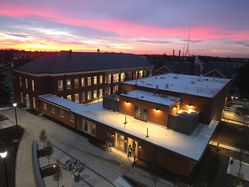
The Children’s National Research & Innovation Campus (RIC), the first-of-its-kind pediatric research and innovation hub located in Washington, D.C., now has its first occupant – the Rare Disease Institute (RDI).

The institute, which includes the largest clinical group of pediatric geneticists in the nation, focuses on developing the clinical care field of the more than 8,000 rare diseases currently recognized and advancing the best possible treatments for children with these diseases.

Image: https://innovationdistrict.childrensnational.org/

Read More
Bipartisan Commission on Bio Defense Logo

The Apollo Program for Biodefense – Winning the Race Against Biological Threats – Bipartisan Commission on Biodefense

By News Archive

Bipartisan Commission on Bio Defense Logo

The COVID-19 pandemic is a stark wake-up call for the United States to take biological threats seriously. The virus is on track to take the lives of more than 400,000 Americans and cost our economy trillions of dollars. The risks of future pandemics increase as technological progress eases barriers to modifying pathogens, raising the specter of novel biological agents causing diseases much worse than humanity has ever faced. Meanwhile, U.S. vulnerabilities to biological attacks have never been clearer to our adversaries.

However, there is a path forward. The Apollo Program for Biodefense would provide the United States the opportunity to mobilize the nation and lead the world to meet these challenges: a world where we detect and continually trace any new pathogen from the source; where we can distribute rapid point-of-person tests to every household in the country within days of that detection; where effective treatments are already in-hand; where vaccine development and rollout occur in weeks rather than years; and where pandemics will never again threaten the lives and livelihoods of Americans and people around the world.


Read More

Search

You have successfully subscribed to the newsletter

There was an error while trying to send your request. Please try again.

BioHealth Innovation will use the information you provide on this form to be in touch with you and to provide updates and marketing.