Category

News

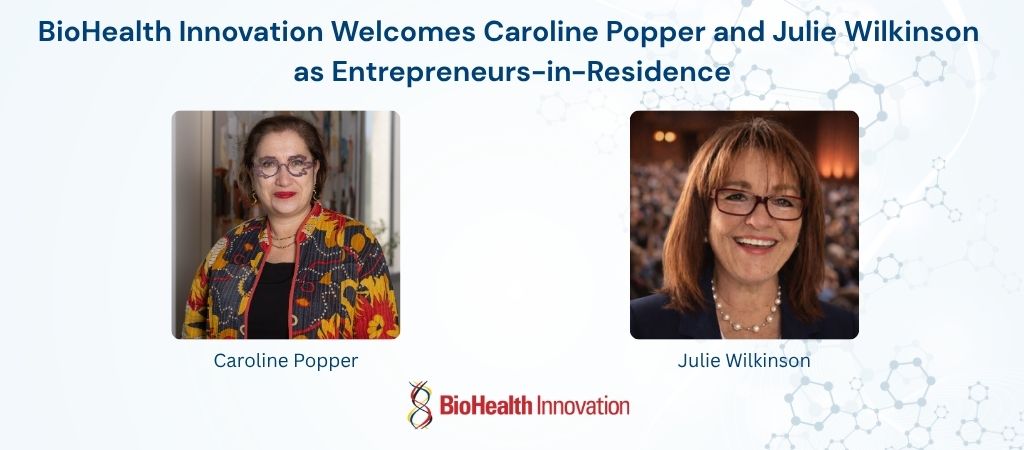
BioHealth Innovation Welcomes Caroline Popper and Julie Wilkinson as Entrepreneurs-in-Residence

By News

BioHealth Innovation, Inc. (BHI) is pleased to announce the addition of Caroline Popper and Julie Wilkinson as Entrepreneurs-in-Residence (EIRs). Together, they bring decades of experience across medical technology, diagnostics, digital health, commercialization strategy, FDA pathways, manufacturing, corporate development, and venture-building.

Popper is a business leader, physician, and lawyer with more than 30 years of experience in medical technology, diagnostics, and the life sciences. Her work has focused on technologies and services that improve healthcare efficiency, with a growing emphasis on the intersection of healthcare, biology, technology, and artificial intelligence.

She has held operational and strategic roles at BD and bioMérieux, served as Chief Business Officer of MDS Proteomics, founded Popper and Company, and co-founded The Sherpanis with Julie Wilkinson. She also served as Chief Commercial Officer of Johns Hopkins Precision Medicine and led commercialization activities for the Johns Hopkins Applied Physics Lab Healthcare Mission Area. She currently serves as co-chair of the American Bar Association Healthcare Section AI Task Force.

Wilkinson is a scientist, C-level executive, and entrepreneur with more than 30 years of experience advancing MedTech innovations through FDA clearance and GMP manufacturing across medical devices, digital health, and in vitro diagnostics. She has led R&D efforts at major health technology companies, including Abbott, Beckman Coulter, and Agilent, and founded and grew a life science service company from zero to $10 million before a successful exit.

Her expertise spans FDA product development pathways, MedTech technology readiness, investor diligence, product-market fit, value proposition development, business model design, and commercialization strategy. She was also part of the $2 billion RADx Tech NIBIB initiative, which helped create U.S. manufacturing capacity for COVID-19 tests, and has led company teams through FDA authorization and manufacturing scale-up for new diagnostics.

“Caroline and Julie bring the kind of hands-on operating experience that is invaluable to entrepreneurs and early-stage companies,” said BHI President and CEO, Rich Bendis. “Their combined expertise in diagnostics, MedTech, FDA strategy, commercialization, manufacturing, AI, and venture-building will strengthen BHI’s ability to support innovators as they move from promising technologies to market-ready solutions.”

“Caroline and I are very excited to join the BHI Entrepreneur-in-Residence team and support our capital region entrepreneurs as they accelerate the transformation of innovative ideas into market-ready products. Turning an idea into a successful commercial product takes far more than funding and determination, it requires the collaboration of experienced experts working together as an active team. The Entrepreneur-in-Residence program led by Rich Bendis exemplifies that collaborative approach and provides entrepreneurs with the strategic support needed to move innovation forward,” said Julie Wilkinson, New Entrepreneur-in-Residence, BioHealth Innovation.

As Entrepreneurs-in-Residence, Popper and Wilkinson will work with BHI and its partners to help emerging companies evaluate technology readiness, refine commercialization strategies, navigate regulatory and development milestones, assess market opportunities, and build stronger pathways toward investment, partnership, and growth.

Their addition reflects BHI’s continued commitment to expanding its EIR network with leaders who have deep technical expertise, operating experience, and a strong understanding of what it takes to move biohealth innovations from concept to commercialization.

Organizations and Institutions interested in EIR support through BHI are encouraged to contact Rich Bendis, President and CEO of BioHealth Innovation, at rbendis@biohealthinnovation.org.

About BioHealth Innovation, Inc.

BioHealth Innovation, Inc. (BHI) is a nonprofit innovation intermediary that accelerates the commercialization of promising biohealth technologies. BHI works with entrepreneurs, startups, research institutions, federal laboratories, universities, investors, and industry partners to help move science from discovery to market.

Through its Entrepreneurs-in-Residence program, non-dilutive funding support, international soft-landing services, and commercialization expertise, BHI helps companies and innovators strengthen business strategies, pursue funding, connect with partners, and navigate the path toward growth. BHI is also a founding member and manager of the BioHealth Capital Region brand, supporting the continued development of Maryland, Washington, D.C., and Virginia as one of the nation’s leading life sciences clusters.

Maryland Stem Cell Research Fund Hosts 2026 Stem Cell and Regenerative Medicine Tech Showcase in Baltimore

By News

BALTIMORE, Md., May 12, 2026 — The Maryland Stem Cell Research Fund (MSCRF) hosted its 3rd Annual Stem Cell and Regenerative Medicine Tech Showcase on April 30, 2026, at City Garage in Baltimore, bringing together researchers, entrepreneurs, investors, and industry leaders, including a keynote by Maryland Lieutenant Governor Aruna Miller, to highlight Maryland’s growing leadership in regenerative medicine. The event showcased companies such as Nanochon, Theradaptive, and Seraxis, and drew investors and advisors from J.P. Morgan, Anzu Partners, SOSV, and Newpath Partners, among others.

Hosted in collaboration with the Maryland Department of Commerce and Blackbird Laboratories, the full-day event welcomed more than 160 attendees and featured pitch presentations, keynote remarks, an Oxford-style debate, and a networking and poster reception. The program centered on advancing Maryland’s regenerative medicine ecosystem by connecting innovators with investors, industry experts, and partners who can help move promising technologies toward commercialization and patient impact.

Pitch presentations spanned the full arc of translational regenerative medicine and featured primarily MSCRF-supported awardees, including academic innovators, early-stage ventures, and growth-stage companies. Sixteen pitches from Maryland-based companies and academic researchers showcased technologies across the regenerative medicine pipeline. Academic presenters included Warren Grayson, Michael Anderson, Annie Kathuria, and Hee Chee Choi from Johns Hopkins University, as well as Miroslaw Janowski from the University of Maryland. Companies presenting included Caleo Biotechnology, Stemora Inc., Modelus, Phycin Inc., Nanochon, Inc., miRecule, Sereneuro Therapeutics, Theradaptive, HoH Cells, Diagnostic Biochips, and Seraxis.

“Maryland continues to demonstrate remarkable strength in stem cell and regenerative medicine. This showcase highlights the quality of innovation taking place across our state. By bringing the community together under one roof, we are helping to create the conditions for collaboration, investment, and long-term growth in this sector.” said Ruchika Nijhara, PhD, Executive Director of MSCRF

The event also reflected the shared commitment of MSCRF, Blackbird Laboratories, and the Maryland Department of Commerce to supporting innovation, entrepreneurship, and life sciences development in Maryland.

“MSCRF is a crucial organization in our state’s life sciences funding ecosystem and a natural partner for Blackbird Laboratories,” said Matt Tremblay, PhD, CEO of Blackbird Laboratories. “We were delighted to co-host the 2026 Stem Cell and Regenerative Medicine Tech Showcase and support a platform that helps innovators gain visibility, receive meaningful feedback, and build the connections needed to move promising science closer to commercial and patient impact.”

“Maryland Department of Commerce was proud to support this year’s Tech Showcase, which brought together a wide range of partners to promote and advance life sciences in Maryland,” said Matthew Cimino, PhD, Senior Manager, Business Development, Life Sciences, Maryland Department of Commerce. “The event featured an inspiring group of spin-outs from our flagship universities, including companies attracting significant capital and improving the health and lives of people in Maryland and beyond.”

The event also included an Oxford-style debate on organoids versus animal models in drug discovery and testing, featuring Stephen Horrigan, PhD, Chief Scientific Officer of Noble Life Sciences, and Annie Kathuria, PhD, Assistant Professor in the Department of Biomedical Engineering at Johns Hopkins University. The discussion explored predictive value, ethical considerations, and translational relevance in advancing new approaches to drug discovery and testing.

In her keynote remarks, Maryland Lieutenant Governor Aruna Miller highlighted the vital role of regenerative medicine in delivering life-saving treatments and reaffirmed the state’s commitment to supporting MSCRF’s efforts to improve health outcomes, create high-quality jobs, attract investment, and strengthen Maryland’s life sciences economy.

MSCRF also recognized this year’s review panelists for contributing perspectives from venture, strategic, nonprofit, and institutional investment organizations. Participants included Matt Tremblay, Blackbird Laboratories; Deborah Hemingway, Ecphora Capital; Bob Storey, LaunchPort; Eddie Cherok, Blackbird Laboratories; Prateek Katti, Newpath Partners; Cathryn Paine, Anzu Partners; Brett Shealy, J.P. Morgan; Parsa Amiri, SOSV; Tien Wong, Opus8; Sara Dauber, J.P. Morgan; Julie Lenzer, ADJ Celebration; Chris Steele, MTEC; Calvin Aubrey, Broadoak Capital Partners; John Dierkes, Pickwick Capital Partners; Sammy Datwani, Life Science Angels; and Jack Miner, TEDCO.

Special thanks are due to the event sponsors, whose generous support helped make the Showcase possible.

The Tech Showcase is one of the ways MSCRF supports Maryland’s regenerative medicine ecosystem—from a researcher’s earliest grant to the companies that spin out of the lab and the financing rounds that follow. Through funding, convening, and ecosystem-building efforts, MSCRF continues to help advance promising science, support commercialization, and strengthen Maryland’s position as a leader in stem cell and regenerative medicine.

About the Maryland Stem Cell Research Fund
The Maryland Stem Cell Research Fund supports stem cell and regenerative medicine research, innovation, and commercialization in Maryland. Through its funding programs and ecosystem-building activities, MSCRF helps advance promising technologies and strengthen Maryland’s leadership in regenerative medicine.

Rich Bendis Featured in PharmaBoardroom Interview on the BioHealth Capital Region

By News

Rich Bendis, Founder, President and CEO of BioHealth Innovation, Inc. (BHI), was recently featured in PharmaBoardroom for a conversation on the growth of the BioHealth Capital Region and the role BHI plays in helping life sciences companies move from promising ideas to real commercial opportunities.

In the interview, Rich reflects on the early need that led to the creation of BHI. The region already had world-class research, major federal assets, leading academic institutions, and a strong base of life sciences companies. What was missing was a stronger bridge between science, entrepreneurs, investors, industry, and the market. BHI was built to help fill that gap.

The conversation also looks at how the BioHealth Capital Region became a more connected and recognized life sciences cluster across Maryland, Washington, D.C., and Northern Virginia. Rich discusses why regional collaboration matters and how a shared identity has helped strengthen the area’s national and global position.

The article touches on the funding challenges facing early-stage biotech companies today, including tighter venture capital markets and greater pressure on non-dilutive funding programs. Rich shares how BHI works with companies to pursue SBIR and other federal funding opportunities, strengthen proposals, connect with investors, and identify strategic partners.

Rich also discusses BHI’s work with international companies looking to enter the U.S. market. That support often goes beyond simple introductions and includes helping companies understand market fit, U.S. presence, reimbursement, intellectual property, and the partnerships needed to grow successfully.

The interview offers a thoughtful look at where the BioHealth Capital Region has been, where it is today, and how BHI continues to support entrepreneurs, companies, and partners working to bring new health technologies forward.

Read the full PharmaBoardroom interview to learn more about Rich’s perspective on BHI, the BioHealth Capital Region, and the future of life sciences commercialization.

Thank you to PharmaBoardroom for the opportunity to share this story and highlight the work happening across the BioHealth Capital Region.

How Smart Incentives Shape BioHealth Growth: Ellen Harpel on Economic Development, Accountability, and Regional Competition on BioTalk

By BioTalk with Rich Bendis Podcast, News

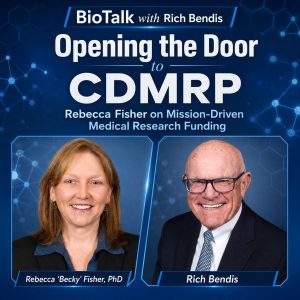
In this episode of BioTalk with Rich Bendis, Ellen D. Harpel, Ph.D., Founder of Smart Incentives, joins the conversation to explore a topic that has shaped the growth of the BioHealth Capital Region but has rarely been discussed directly on the podcast: economic development incentives. Ellen explains why state and local governments use incentives, how they influence business location and expansion decisions, and why effective programs need clear goals, active management, performance measures, and public accountability.

The discussion looks at how incentives support companies across the full business lifecycle, from startups and emerging firms to major employers making large-scale regional investments. Ellen and Rich also examine how recent biohealth activity in Maryland and Virginia reflects the importance of workforce development, site selection, public-private collaboration, and regional thinking. A win in Maryland, Virginia, or Washington, D.C. strengthens the larger BioHealth Capital Region ecosystem.

Listen move via your favorite podcast platform:
Apple: https://apple.co/3R1JXVJ
Spotify: https://bit.ly/4npHNLF
iHeart Music Podcasts: https://ihr.fm/4dCjHtC
YouTube Music Podcasts: https://bit.ly/4d4LpiM
Amazon Music Podcasts: https://amzn.to/4ffpcjb
TuneIn: https://bit.ly/4tCqlVS

Ellen also shares how organizations like BHI and Smart Incentives help companies, communities, and decision makers better understand the resources available to support growth, including financing programs, investor tax credits, grants, incubators, accelerators, and other support services. The episode closes with a practical look at transparency, evaluation, and why better data helps policymakers, economic developers, companies, and communities make stronger decisions about incentive programs.

Editing and post-production work for this episode was provided by The Podcast Consultant. https://thepodcastconsultant.com/

Ellen D. Harpel, Ph.D., is the Founder of Smart Incentives, which helps communities make sound decisions throughout the economic development incentives process. Launched in 2013, Smart Incentives works with state, local, and national governments to design and implement incentive programs that are effective and responsible, with a focus on compliance monitoring, evaluation, transparency, and lasting community benefits. Ellen is also a Senior Research Fellow with the Center for Regional Economic Competitiveness and an Affiliate Faculty member with the Schar School of Policy and Government at George Mason University.

ARPA-H Draft SBIR/STTR Solicitation Creates New Planning Opportunity for Small Business Health Innovators

By News

The Advanced Research Projects Agency for Health (ARPA-H) has released a draft solicitation for its upcoming Small Business Innovation Research (SBIR) and Small Business Technology Transfer (STTR) opportunity, giving small businesses and entrepreneurs time to review the topic areas, understand the requirements, and prepare ahead of the final solicitation.

For small companies working to move ambitious health technologies from concept toward commercialization, this draft solicitation creates an important planning window. The opportunity is relevant to entrepreneurs, academic spinouts, and translational research teams developing technologies aligned with ARPA-H’s mission to accelerate better health outcomes through high-potential research and development.

ARPA-H’s Small Business Program provides funding through SBIR and STTR awards, along with access to expert guidance, technical resources, and connections with partners, investors, and collaborators. Awards are generally issued as contracts of up to $600,000 for Phase 1 and up to $3.5 million for Phase 2, depending on progress against ambitious milestones consistent with ARPA-H’s model.

Full details are available here: https://arpa-h.gov/explore-funding/sbir

The current draft solicitation includes seven topic areas:

Topic 1: Development of an annual test to inform women about their future fertility

Topic 2: Versatile Bioadhesives

Topic 3: Universal Platform for Living Adaptive Toxin-removal (UNI-PLAT)

Topic 4: Breaking Ground: The First Curative, Non-Invasive, Long-Lasting Therapy for Endometriosis

Topic 5: ARPA-H Lineage Topic

Topic 6: Rapid Comprehensive Diagnostic Test for Multi-System Autoimmune Disease

Topic 7: Virtual Human Brain for the Development of Neurosurgical Robotics

Together, these areas reflect the range of health challenges being advanced through small business-driven innovation. The topics span women’s health, advanced materials, diagnostics, autoimmune disease, toxin removal, therapeutic development, and neurosurgical robotics, creating potential entry points for companies and research teams with technologies that can meet clear technical milestones.

The draft solicitation is currently available for review and planning purposes. The final solicitation will serve as the official funding opportunity announcement. ARPA-H notes that this is an upcoming opportunity and is not yet accepting applications. The ARPA-H Solutions site is expected to open for applications after the final solicitation is posted, with a target date of June 11, 2026.

Key dates currently listed by ARPA-H include:

June 11, 2026: Target date for the ARPA-H Solutions site to open for applications after the final solicitation is posted

July 10, 2026: Solution Summaries due by 11:59 p.m. ET

September 9, 2026: Technical Oral Presentations, Cost Proposals, and Task Description Documents due by 11:59 p.m. ET for applicants who are successful in the Solution Summary phase and encouraged to pitch

ARPA-H is also hosting a Small Business Program Proposers’ Day on June 11, 2026. The event will give potential applicants the opportunity to hear directly from ARPA-H leaders about the small business program, the solicitation, the application and contracting process, and the topic areas being advanced by Program Managers.

Eligible proposers must be small businesses with no more than 500 employees, majority ownership by U.S. citizens or another U.S.-based small business, and all work performed in the United States. SBIR awards include specific requirements for Primary Investigator employment and the share of work performed by the small business. STTR awards require a research institution partner and defined workshare requirements for both the small business and the research institution.

Small businesses, entrepreneurs, and translational research teams working in the listed topic areas are encouraged to review the draft solicitation, assess potential alignment, and begin preparing early.

Opportunities like this are important for companies working at the edge of health innovation, where strong science, clear milestones, and the right federal pathways can help move promising technologies toward real-world use.

Georgetown University Research & Innovation Showcase 2026 Recap

By News

On April 22, 2026, Georgetown University hosted its annual Research & Innovation Showcase, bringing together faculty, students, investors, entrepreneurs, and regional leaders for a full day focused on translating discovery into real-world impact. Held at the Rafik B. Hariri Building, the event centered on this year’s theme, “Partnerships Power Possibilities,” highlighting how collaboration drives innovation from lab to market.

“The 2026 Georgetown University Research & Innovation Showcase highlighted the need for strategic partners to achieve research translation and innovation development,” said Tatiana Litvin-Vechnyak, Georgetown’s vice president for technology commercialization. “This year’s event brought together more than 400 investors, entrepreneurs, industry stakeholders, faculty, and students, all critical to our ability to achieve this goal. BHI’s collaboration over the years and sponsorship of the showcase has been crucial to this work.”

BioHealth Innovation was well represented throughout the day, including Founder, President, and CEO Rich Bendis, Entrepreneurs-in-Residence Luis T. Gutierrez, Ray Blanchard, and Steve Wolpe, along with Mona Suliman, Life Sciences Business Strategist. Their presence reflects an ongoing collaboration between BHI and Georgetown that has been in place for several years, where BHI’s Entrepreneurs-in-Residence work alongside Georgetown’s Office of Technology Commercialization and Georgetown Tech Ventures to help evaluate, develop, and advance early-stage technologies toward commercialization.

The program followed a structured flow designed to move from high-level insights to active engagement, beginning with the “Discovery to Impact” opening panel, followed by research presentations, a reverse pitch session with industry and investors, a new venture showcase, and concluding with awards and networking.

The opening panel stood out as a defining moment of the event. Moderated by Georgetown’s Vice President of Technology Commercialization, Tatiana Litvin-Vechnyak, the discussion featured leaders who shared firsthand accounts of how academic research can evolve into FDA-approved products with real patient impact.

“The detailed stories shared during the opening panel made it clear how innovation that begins in an academic setting can successfully translate into therapies that reach patients well beyond the university,” said Luis T. Gutierrez, Entrepreneur-in-Residence.

Across the broader showcase, the diversity of innovation on display was a consistent theme. From cancer therapeutics to AI-enabled research platforms and socially driven ventures, the range of subject matter reflected both the depth of Georgetown’s research and the evolving priorities of the biohealth ecosystem.

“There was a strong variety of startup subject matter represented, which made the event both engaging and insightful,” said Mona Suliman. “The reverse pitch format, in particular, was a great idea and provided valuable insights into how companies and investors are thinking.”

The Industry and Investor Reverse Pitch session drew strong engagement from attendees, emphasizing early-stage conversations and relationship building. Many of the participating organizations were based within the BioHealth Capital Region, reinforcing the importance of local connectivity in driving innovation forward.

“This session really underscored the value of establishing early dialogue between innovators and funders,” noted Ray Blanchard. “It created a space for understanding priorities on both sides before formal investment conversations begin.”

The New Venture Showcase highlighted emerging companies built around Georgetown research, including Pushcart Therapeutics, where BHI EIR Steve Wolpe serves as CEO. A key moment from the session was the first public presentation of the company by Dr. Louis Weiner, Director of Georgetown’s Lombardi Cancer Center.

“The Georgetown showcase was an excellent mix of investors, strategics and Georgetown spinout companies,” said Steve Wolpe, Entrepreneur-in-Residence. “Dr. Weiner’s research was identified by BHI as having great potential for a spinout, and PushCART was co-founded to advance that opportunity. The company is developing DRILL technology that allows immune cells to penetrate solid tumors, and the preclinical data presented was compelling. We are currently closing a seed round with plans to enter first-in-human clinical trials within the next two years.”

The presentation underscored the role that structured partnerships play in advancing promising academic research into venture-backed companies with a clear path toward the clinic.

Beyond the formal programming, the event also benefited from strong participation across the Georgetown community, with attendees spanning faculty, students, alumni, and regional stakeholders. The presence of Nina Albert, Deputy Mayor of Washington, DC, added important context around public sector initiatives supporting innovation and investment across the region, including the city’s efforts to build a stronger venture and startup ecosystem.

“The networking session brought together a great mix of speakers and attendees,” said Suliman. “It created meaningful opportunities to connect across sectors.”

The day concluded with an awards ceremony recognizing innovation and entrepreneurship within the Georgetown community, reinforcing the institution’s ongoing commitment to advancing research with real-world impact.

“The strength of efforts like this is in the partnership,” said Rich Bendis. “As Georgetown continues to expand its startup pipeline and its collaboration with BHI, events like this reinforce that successful commercialization is built through sustained partnership, shared expertise, and consistent engagement across the ecosystem.”

Nexus234 Innovation District debuts in Manassas and George Mason is in the heart of it

By News

Today during a naming event in Manassas, Virginia, George Mason University, Prince William County, and the City of Manassas officially unveiled Nexus234 Innovation District, marking a milestone that has been decades in the making.

The nearly 6,000-acre destination, named for the Route 234 corridor that runs through its heart, is Northern Virginia’s first Innovation District and positions the region as a national destination for research-driven industry. Centered around Innovation Park alongside George Mason’s Science and Technology Campus, Nexus234 connects researchers, entrepreneurs, and technology companies ranging from startups to global firms across sectors including life sciences, aerospace, defense, semiconductor, data centers, and AI infrastructure.

Designed to accelerate the path from discovery to deployment, Nexus234 provides an environment where research, workforce training, and industry collaboration intersect to support economic growth and commercialization.

“None of this happened all of a sudden. It was years in the making,” said George Mason President Gregory Washington. “You have the right community, you have the right components, you have the right leadership. You mix all that together and throw in Virginia’s largest R1 institution. You want an education system that produces a pipeline of high paying jobs, that partners with the business community and provides accountability to the public. That’s what we’ve been putting in place at George Mason.”

The naming event coincided with the Association of University Research Parks (AURP) conference, bringing visitors from across the country to tour Nexus234 and engage with researchers, students, and anchor companies including Micron, General Dynamics’ Progeny Systems, and American Type Culture Collection (ATCC). Attendees got a firsthand look at workforce training programs, an international soft-landing initiative, and the NOVA LIVE dynamic campus. Leaders emphasized Nexus234’s competitive advantage for development that includes tech-flex industrial space, incubator and accelerator programs, and sites for commercial and mixed-use expansion.

“Prince William County is building a destination for discovery,” said Chair-at-Large Deshundra Jefferson, Prince William Board of County Supervisors. “Nexus234 reflects our long-term strategy to attract high-value industries, support groundbreaking research, and ensure companies have the space, talent, and infrastructure they need to grow.”

Nexus234 builds on 30 years of public–private collaboration, formalized through a $2.6M GO Virginia grant to create Northern Virginia’s first innovation district in June 2025 and matched by $1.3M in local investments from founding partners: ATCC, Didlake, ECU Communications, Dominion Energy, Employment Enterprises Inc., I-66 Express Mobility Partners, Garcia Family Foundation, Micron Technology Inc., Northern Virginia Community College, Vanderpool, Frostick & Nishanian, and Virginia Innovation Partnership Corporation (VIPC).

“Nexus234 serves as a front door for companies like ours,” said CEO Ross Dunlap, Ceres Nanosciences. “As the first Endeavor incubator graduate, we have continued to grow within the innovation district and now operate more than 12,000 square feet of wet‑lab and manufacturing space, supporting the global distribution of our products. We’ve benefited from collaboration with local scientists, access to shared university facilities and equipment, hiring local talent, and regular opportunities to engage.”

Nexus234 includes approximately 330 acres available for laboratory, R&D, manufacturing, and office development, with a portion of land publicly controlled to support coordinated public-private growth

“Beyond economic metrics, Nexus234 represents a community investment—creating high-quality jobs, generating a new tax base, and reinforcing Manassas as a place where historic charm and forward-looking innovation come together,” said Mayor Michelle Davis-Younger, City of Manassas. “As new companies are generated, and local and existing firms expand, the district is poised to become a nationally recognized destination for research and advanced industry.”

Conveniently located with access to Interstate 66, major rail corridors, and Manassas Regional Airport, and proximity to Washington Dulles International Airport, Nexus234 offers the connectivity to support both business growth and regional accessibility. With its proximity to federal agencies and one of the nation’s largest data center ecosystems, Nexus234 positions the region to attract and support companies operating at the forefront of technology and applied research.

“Growing the BioHealth Capital Region of Tomorrow”: BHCR Week 2026 Set for September 15th, 16th, and 17th at USP

By News

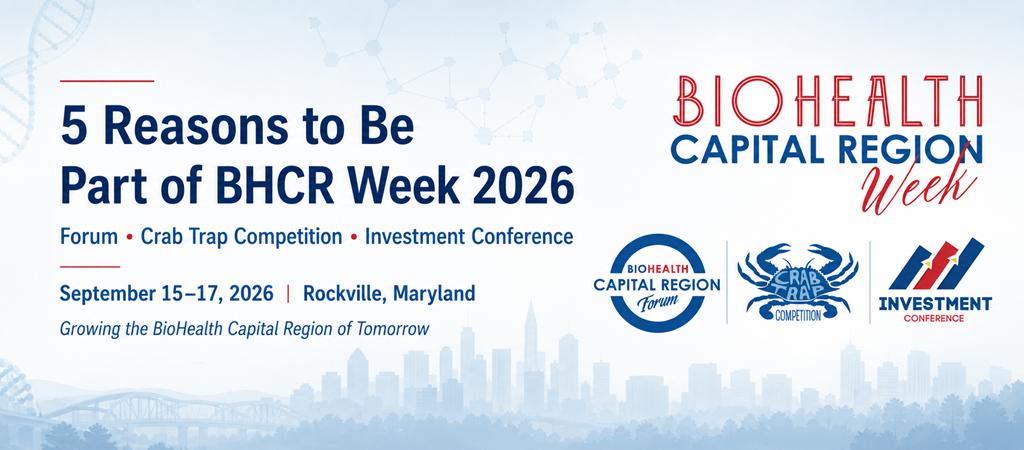
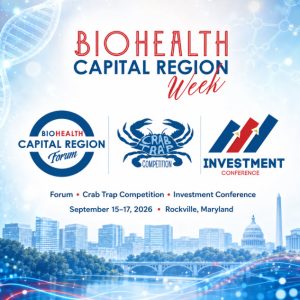
BioHealth Capital Region Week will return on September 15 through 17, 2026, at US Pharmacopeia in Rockville, Maryland, bringing together leaders from industry, academia, government, and investment for three days focused on the future of one of the nation’s leading biohealth ecosystems. The event will again feature the BioHealth Capital Region Forum, the Crab Trap Competition, and the Investment Conference.

This year’s Forum theme, “Growing the BioHealth Capital Region of Tomorrow,” reflects both the region’s momentum and the need for continued collaboration at a time when many organizations are navigating a more uncertain funding environment. As public funding conditions shift, the region’s long-term strength will depend on its ability to deepen partnerships, support commercialization, attract investment, and build new pathways for growth. The Forum will serve as a place for those conversations to happen.

Registration for all BioHealth Capital Region Week events will be opening soon. Attendees can expect a strong lineup of programming, networking, and opportunities to connect with the people and organizations shaping the future of biohealth across Maryland, Virginia, and Washington, D.C.

Sponsorship opportunities are also available for organizations that want to be part of the week’s visibility and engagement. Available options include Lead Headliner Sponsorship, which offers top-level recognition throughout the week and the VIP Leadership Dinner, Standard Sponsorship, which includes logo recognition and VIP dinner access, End-of-Day Reception Sponsorship, which adds event-specific recognition during a featured networking reception, VIP Leadership Dinner Sponsorship, which provides recognition for that evening’s key opinion leader gathering and an opportunity to address attendees, and Display Table Sponsorship, which offers an on-site presence in a limited table area positioned near the main flow of activity. Sponsorship support helps make the week’s programming and convening possible.

For more information about sponsorship opportunities, please contact Rich Bendis at rbendis@biohealthinnovation.org  and Andy Eckert at aeckert@biohealthinnovation.org.

Building Georgetown Tech Ventures and Strengthening the Startup Pipeline from Academic Research

By BioTalk with Rich Bendis Podcast, News

How do universities move promising discoveries out of the lab and into the market? In this episode of BioTalk, Tatiana Litvin-Vechnyak, Vice President of Georgetown’s Office of Technology Commercialization, Christon Hill, Program Manager for Georgetown Tech Ventures, and Jennifer Butler, Entrepreneur-in-Residence with BioHealth Innovation, discuss how Georgetown is building a stronger pipeline from academic science to startup formation. The conversation examines how Georgetown’s commercialization efforts are evolving, how GTV supports faculty founders, and why structured programming, outside expertise, and stronger ecosystem connections matter for turning research into real-world impact.

The discussion also explores the “missing middle” between discovery and commercialization, the role of Entrepreneurs-in-Residence in advancing founders and technologies, and how partnerships among Georgetown, GTV, and BioHealth Innovation are helping to create a more durable and commercially focused innovation pipeline. The guests also reflect on Georgetown’s place within the BioHealth Capital Region and what success will look like as the university continues building a stronger culture of entrepreneurship and company creation.

Listen via your favorite podcast platform:
Apple: https://apple.co/3OjZf7f
Spotify: https://bit.ly/4vyGePd
iHeart: https://ihr.fm/4tfSJ0p
YouTube Podcasts: https://bit.ly/4sCEEZK
TuneIn: https://bit.ly/4mz5j8x

Editing and post-production work for this episode was provided by The Podcast Consultant.

Tatiana Litvin-Vechnyak, Ph.D., is Vice President of Georgetown’s Office of Technology Commercialization, where she leads the university’s efforts to translate research discoveries into real-world impact through licensing, startup creation, and innovation support. Since joining Georgetown in 2023, she has helped expand the university’s commercialization infrastructure, including securing the U.S. Economic Development Administration Build to Scale grant that launched Georgetown Tech Ventures. With more than 20 years of experience in intellectual property, licensing, and business development, she previously served in leadership roles at Rutgers University, where she helped advance major innovation and venture development initiatives. She holds a Ph.D. in Pharmacology and is a Registered Patent Agent.

Christon Hill is Program Manager for Georgetown Tech Ventures in Georgetown University’s Office of Technology Commercialization, where he develops programs, partnerships, and founder support pathways that help move promising research toward venture creation, strategic partnerships, and real-world use. With an interdisciplinary background spanning biotechnology, biology, and the humanities, he brings a practical and market-aware approach to early-stage innovation, with experience in venture development, ecosystem building, and translating complex ideas for investors, partners, and non-technical audiences. He is a graduate of Georgetown’s biotechnology master’s program, a Marine veteran, and a cross-sector operator focused on helping founders and institutions turn strong ideas into credible, actionable opportunities.

Jennifer Butler is a distinguished global commercial executive and strategic leader with nearly 20 years of experience helping biotechnology companies move from early development through commercialization. She serves as an Entrepreneur-in-Residence with BioHealth Innovation and served as Montgomery County’s first Executive-in-Residence, a role created through a collaboration between Montgomery County and BioHealth Innovation to provide technical assistance to local biotech startups. Across her career, she has brought a strong commercial perspective to emerging companies, helping founders sharpen strategy, accelerate development, and navigate the path toward growth and commercialization.

Episode Transcript.

AI in Grant Writing: Where it Helps and Where it Hurts

By EIR Insights, News

By Catherine Leasure, Ph.D., BHI Life Sciences Business Strategist – If you’ve written a grant recently, you’ve probably wondered whether AI could make the process easier. Maybe you’ve already tried it. The honest answer is that AI can help, but how much depends entirely on what you bring to it. When you know what you’re doing, it gets you to a solid draft faster. However, without a strong grasp of the process behind it, it can produce polished-sounding text that misses the mark in ways that aren’t always obvious until a reviewer or experienced grant writer points them out.

Where AI Earns Its Keep

The tasks where AI performs best are the ones that are time-consuming but relatively mechanical. Generating a document outline that accounts for both grant requirements and your specific project content is a good example. What might take an hour of cross-referencing a funding opportunity announcement can be done in minutes with the right prompt. From there, AI can help turn that outline into a working first draft and translate dense technical language into plain descriptions for non-specialist reviewers, which is particularly useful when generating ancillary documents like abstracts or project summaries that need to be accessible to a broad audience.

AI also shines in the later stages of drafting. Grant applications are long documents, and inconsistencies are easy to overlook when you’ve been working on the proposal for weeks or months. Terminology that shifts between sections that were written by different people, early claims that aren’t fully supported later in the document, and overly wordy sentences are all the kinds of issues that AI excels at catching and fixing. It can also serve as a compliance checker, making sure required sections are present and that the structure of your application matches what the solicitation requires.

None of this replaces the thinking that goes into a competitive application. But it does free up time and mental energy for the parts that require it.

Where AI Falls Short

The same confidence that makes AI useful in the drafting process can work against you when the content and strategy require nuance. AI can misrepresent novel technologies, fabricate citations, or produce technically plausible descriptions that are subtly wrong (this is called hallucinating). For early-stage companies with innovative science, this is a real risk. AI can only work with what you give it. If you’re not providing detailed, accurate information about your technology and approach, it will fill in the gaps on its own, and not always correctly. You need someone who actually understands the technology both guiding the prompts and reviewing anything AI generates before it goes into your final draft.

Beyond accuracy, there’s a layer of strategic knowledge that AI doesn’t have access to. It can’t tell you how a program officer has been framing their priorities in recent conversations, what a review panel tends to weigh most heavily, or whether your project is actually a good fit for a particular solicitation before you invest time writing your proposal. That kind of information comes from reaching out to and meeting with program officers before you submit. These conversations can reshape an application in ways that no AI tool can replicate.

Then there’s the writing itself. Even the best prompts can produce text that experienced reviewers recognize immediately: sentence structures like “it’s not X, it’s Y,” excessive adjectives, and the overuse of certain punctuation are all patterns that show up repeatedly in AI-generated text. Beyond the stylistic tells, AI tends toward a kind of confident vagueness that sounds thorough but doesn’t actually say much. In competitive grant programs, that kind of generic writing loses. If AI contributes to any part of your draft, it’s the grant writer’s job to make sure the final product sounds like it was written by a real person. Reviewers who are engaged with your writing are more likely to be engaged with your science.

Finally, using AI to write your grant poses a potential confidentiality risk that often goes overlooked. When you paste proprietary information about your technology into a public AI tool, that content may be used to train the model, and there is no guarantee it will stay private. Details about your innovation could potentially surface in someone else’s results! Treat any public AI tool the way you would any other unsecured channel: don’t put anything in that you wouldn’t be comfortable sharing publicly.

Agency Guidance on AI Use

Some funding agencies have begun addressing AI use in applications directly. NIH, for example, recently issued guidance stating that applications that are substantially developed by AI will not be considered original ideas of the applicant, and that the NIH employs AI detection tools to identify AI-generated content (NOT-OD-25-132). Applications found to be in violation post-award can face serious consequences, including cost disallowance, grant suspension, or termination. The NSF has taken a slightly more lenient approach, requesting that proposers disclose whether AI tools were used when preparing an application. The NIH and the NSF are not alone in scrutinizing AI use, and it is reasonable to expect other agencies to follow suit as AI use becomes more widespread.

The Bottom Line

AI is a useful tool in the grant writing process, but it works best as a starting point, not a final product. The applications that score well aren’t necessarily the ones with the smoothest prose, they’re the ones that demonstrate a clear understanding of the funding landscape, make a compelling scientific case, and show reviewers that the team behind the project knows what they’re doing. That requires expertise that no prompt can substitute for.

Used effectively, AI can get you to a better draft faster. But knowing how to use it thoughtfully, and knowing when not to rely on it, is itself a skill.

Work with Us

At BHI, we work with clients from the earliest stages of identifying the right funding opportunity through grant submission, including helping determine where AI can speed up the process and where it needs to be set aside in favor of human expertise. Our grant writers have supported over 200 applications, helping clients secure $66M in non-dilutive funding. If you’re working on a grant application and want to make sure you’re using every tool available without sacrificing the quality of your submission, we’d love to talk.

Search

You have successfully subscribed to the newsletter

There was an error while trying to send your request. Please try again.

BioHealth Innovation will use the information you provide on this form to be in touch with you and to provide updates and marketing.