
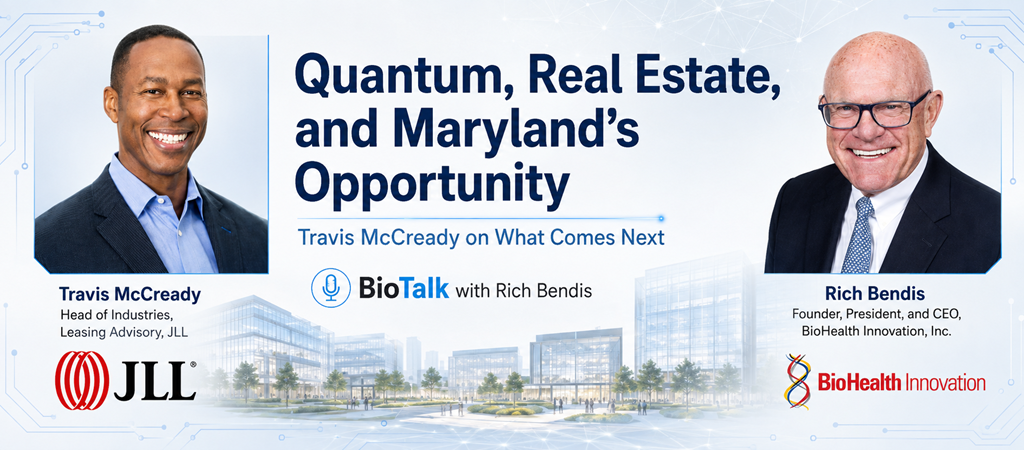
 In this episode of BioTalk with Rich Bendis, Travis McCready, Head of Industries, Leasing Advisory at JLL, joins the conversation to discuss quantum computing, why real estate professionals are paying attention, and what this emerging technology could mean for regions like the BioHealth Capital Region.
Travis explains that quantum computing should be understood as an enabling technology, much like earlier waves of innovation that helped shape new industries, companies, and regional economies. While the field is still developing, he discusses why quantum is no longer just a distant concept and why real estate, infrastructure, workforce, and sector-specific use cases will all play a role in determining which regions lead.
The conversation explores the industry’s most likely to benefit from quantum first, including government and cryptography, life sciences, and finance and insurance. Travis also discusses how quantum computing could support areas such as molecular modeling, materials science, complex risk modeling, and other problems that involve large numbers of interconnected variables.
Listen via your favorite podcast platform:
Apple: https://apple.co/4ggQLHM
Spotify: https://bit.ly/465vcoY
iHeart Podcasts: https://ihr.fm/4670fkc
Amazon Podcasts: https://amzn.to/3vpZDHI
YouTube Music Podcasts: https://bit.ly/4cE5CuP
TuneIn: https://bit.ly/4xIayXR
Rich and Travis also look at the real estate side of quantum, including what makes quantum facilities different from traditional data centers or life sciences buildings. Travis explains why energy, vibration sensitivity, floor loads, electromagnetic shielding, a skilled workforce, and proximity to key research and industry assets all matter when regions consider quantum site selection.
The episode also focuses on Maryland’s position in the emerging quantum economy. Travis and Rich discuss the state’s strengths in life sciences, federal agencies, defense, cybersecurity, cryptography, research universities, and companies such as IonQ. Travis emphasizes that Maryland’s opportunity is not only in building quantum assets, but in translating those assets into commercial activity, workforce development, company formation, and long-term economic growth.
Editing and post-production work for this episode was provided by The Podcast Consultant.
Travis A. McCready is Head of Industries, Leasing Advisory in the Americas for JLL and Chair of the firm’s Global Life Sciences Advisory Board. In this role, he oversees brokerage and advisory work across JLL’s key global industry verticals, including life sciences, healthcare, data centers, energy, security and defense, technology, and higher education. He is also a member of JLL’s Innovation Districts Practice, providing strategic advisory services to innovation districts around the world. Travis has more than 25 years of experience leading public, private, and nonprofit ventures focused on science and technology-based real estate and innovation infrastructure. He also serves on several boards and advisory groups across the innovation, life sciences, academic, and energy sectors.
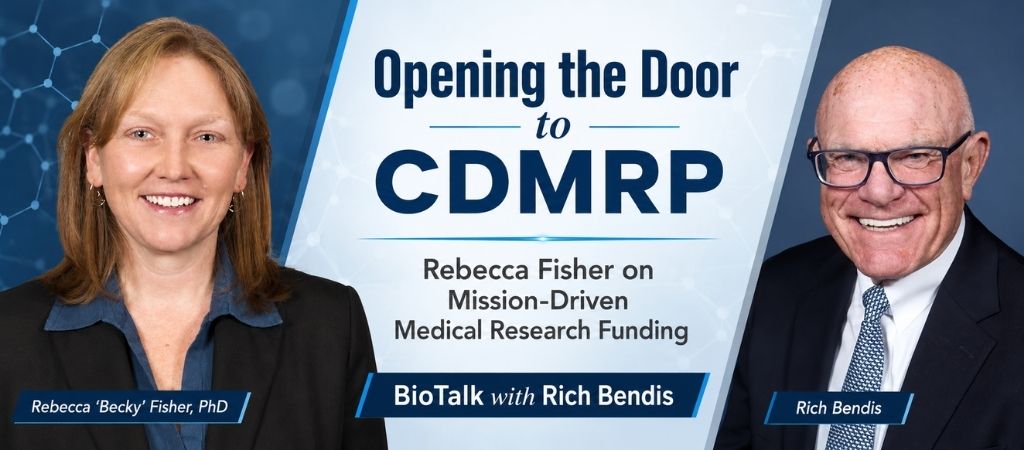
 Opening the Door to CDMRP: Dr. Rebecca Fisher on Mission-Driven Medical Research Funding
In this episode of BioTalk with Rich Bendis, Rebecca “Becky” Fisher, PhD, Deputy Director for Program Management at the Congressionally Directed Medical Research Programs, joins the conversation to help listeners better understand one of the federal biomedical research funding pathways that may be less familiar to many entrepreneurs, researchers, and life science companies.
Dr. Fisher explains how CDMRP works, how it differs from and complements other federal funders such as NIH and ARPA-H, and why its mission is focused on advancing high-impact research that can lead to cures, improved patient care, breakthrough technologies, and clinical benefit. She also discusses the scale and breadth of CDMRP’s portfolio, including its FY26 appropriations of $1.27 billion across 34 program areas and additional targeted topics.
Listen via your favorite podcast platform:
Apple: https://apple.co/4htk2Bp
Spotify: https://bit.ly/4xbHPel
iHeart: https://ihr.fm/4g3OFLr
Amazon: https://amzn.to/3UpI72o
YouTube: https://bit.ly/4fR5wCh
TuneIn: https://bit.ly/45k1lc8
A major focus of the conversation is CDMRP’s unique approach to consumer involvement. Dr. Fisher explains how patients, caregivers, family members, and others with lived experience help shape program strategy, participate in review, and keep funded research connected to the needs of the communities it is intended to serve.
The episode also offers practical guidance for applicants. Dr. Fisher walks through how funding opportunities are developed, where to find open program announcements, how the two-tier review process works, and what makes a strong application stand out. She also shares advice for small businesses, academic investigators, clinicians, translational research teams, and industry partners interested in exploring whether CDMRP may be a fit for their work.
Editing and post-production work for this episode was provided by The Podcast Consultant.
Dr. Rebecca “Becky” Fisher currently serves as Deputy Director for Program Management at the Congressionally Directed Medical Research Programs within the Defense Health Agency, providing senior-level leadership for the successful administration of Congressional appropriations supporting targeted biomedical research. Dr. Fisher has more than 20 years of experience managing and leading complex biomedical research programs within the Department of War. In her current role, she leads CDMRP staff in developing program strategies, facilitating collaborative efforts, and investing funding to further the CDMRP and DoW biomedical research missions. Her work involves extensive engagement with stakeholders from Congress, government, academia, industry, nonprofit, and consumer advocacy organizations. Dr. Fisher received her PhD in Toxicology from the University of North Carolina at Chapel Hill and completed a Postdoctoral Cancer Research Training Award Fellowship at the National Cancer Institute.

 RICHMOND, VA. August 4, 2026 ‐ BRAINBox Solutions today announced a strategic financing to accelerate the development of point-of-care (PoC) and lab-based devices for its BRAINBox TBI diagnostic/prognostic tests for concussion (also known as mTBI or Acute Traumatic Encephalopathy). The financing included equity funding as well as credit facilities from Pivotal Capital Partners and New Horizon Bank. Specific terms were not disclosed.
“The financing reflects the progress we have made in delivering excellent performance in a proprietary assay format, including through our collaboration with Prolight Diagnostics that has demonstrated its Psyro® PoC platform’s suitability for our TBI test as well as other products in our neurology portfolio,” said Donna Edmonds, BRAINBox’s CEO. “We recently entered a development agreement with Prolight and the funding will enable us to develop advanced hardware and software for commercial device and acquire pilot instruments. Development of a PoC device is an important dimension of our strategy, which is to provide the test in hospital laboratories as well is in other settings such as clinics, ambulances, emergency departments, nursing homes, and athletic facilities.”
She added, “We are particularly pleased to have this initial support of Pivotal Capital and New Horizon Bank, two organizations working in concert with us that have strong commitments to growing innovative, entrepreneurial companies.”
The non-exclusive development agreement followed a feasibility study in which Prolight evaluated 260 patient samples from the data set of BrainBox’s HeadSMART II pivotal trial on the Psyros platform using three assays for concussion. The results demonstrated excellent performance.
Prolight’s Pyros technology enables the rapid detection and measurement of single molecules from a drop of blood. Their proprietary and multiplex-capable technology enables the measurement of biomarkers at extremely low concentrations (single digit ng/L).
About BRAINBox Solutions
BRAINBox Solutions is developing the first AI‐enabled, multi‐modality approach for the diagnosis and prognosis of Mild Traumatic Brain Injury, now commonly referred to as a concussion. The company seeks to establish a clinical best‐practice standard for the diagnosis and prognosis of concussion providing information which can support the ability to guide interventions. The initial product incorporates a panel of proprietary, blood biomarkers that can be read in a few moments on a point‐of‐care instrument or using standard laboratory systems, combined with a digital neurocognitive testing platform, to provide a composite TBI injury score. The company is led by key physician and scientific thought leaders in the field and an experienced, clinically focused management team. Learn more at: www.brainboxinc.com
For more information, contact:
Donna Edmonds
CEO
1‐804‐724‐0009
 BioHealth Capital Region Week returns September 15–17, 2026, at US Pharmacopeia in Rockville, Maryland, bringing together leaders from across industry, academia, government, investment, research institutions, economic development, and entrepreneurship.
This year’s theme, “Growing the BioHealth Capital Region of Tomorrow,” reflects a practical question facing the region: How do we turn our scientific assets, federal presence, talent, infrastructure, and industry base into more companies, stronger partnerships, greater investment, and sustained economic growth?
BHCR Week creates three distinct opportunities to take part in that work: the BioHealth Capital Region Forum, the Crab Trap Competition, and the BioHealth Capital Region Investment Conference. Each serves a different audience and purpose, but together they span the full path from ideas and research to company formation, commercialization, financing, and growth.
1. The region’s full biohealth ecosystem will be in one place
BHCR Week is one of the few events where executives, founders, researchers, investors, government leaders, economic development organizations, universities, health institutions, and professional service partners come together around the same regional agenda.
Each year, the event draws hundreds of attendees representing biotech, biopharma, medtech, digital health, academic and research institutions, investment organizations, government agencies, economic development groups, and companies that provide legal, financial, technical, real estate, consulting, and commercialization support.
That mix matters. Most companies do not grow through one relationship or one source of support. They need capital, talent, facilities, regulatory guidance, research partnerships, service providers, customers, and a network that can help them move from one milestone to the next.
BHCR Week gives attendees access to many of those relationships in one place. A founder can meet an investor, an economic development leader, a university partner, and a potential service provider during the same week. An established company can connect with emerging technologies, regional decision-makers, and potential collaborators. Investors can see both the companies seeking capital and the institutions helping create the next generation of opportunities.
2. The program is focused on the issues shaping the region’s next decade
The 2026 program looks beyond a single trend or industry challenge. It will examine the combination of technologies, resources, policies, and partnerships needed for the BioHealth Capital Region to continue growing.
The Forum will include conversations around AI and quantum applications in biohealth, commercialization, financing, economic development, infrastructure, manufacturing, standards, supply chains, workforce, dual-use technologies, company formation, and regional collaboration.
These subjects are connected. Companies need access to capital, but they also need the physical and digital infrastructure to operate. Research institutions need commercialization pathways and experienced leadership. Emerging technologies need practical use cases, trusted standards, and partners capable of moving them into the market. The region must also understand why companies choose to start, remain, expand, or relocate here.
The Forum is designed to bring those conversations together rather than treating them as separate issues. Attendees will hear from leaders who are working on these challenges from different perspectives and have opportunities to connect those ideas to their own organizations.
3. Three different events create three different ways to participate
BioHealth Capital Region Week is not a single-format conference. Its three events are designed for different stages of the innovation and company-growth process.
BioHealth Capital Region Forum
September 15–16, 2026
The Forum is the thought-leadership and regional-convening portion of BHCR Week. Across two days, attendees will hear keynotes, panel discussions, regional updates, and conversations focused on the future of the biohealth ecosystem.
The Forum is a strong fit for company leaders, researchers, entrepreneurs, academic institutions, government agencies, economic development organizations, investors, professional service firms, and anyone working to strengthen the regional life sciences economy.
Attendees should register if they want to understand what is changing across the region, meet decision-makers from multiple sectors, discover potential partners, and take part in conversations about how the BioHealth Capital Region grows from here.
Registration is free thanks to sponsors, but advance registration is required:
https://eventmobi.com/website/BHCR2026
Crab Trap Competition
September 16, 2026
The Crab Trap Competition gives emerging biohealth companies an opportunity to pitch live before investors, judges, industry leaders, and regional partners.
Selected finalists gain more than stage time. They receive visibility across the regional ecosystem, direct feedback, and opportunities to build relationships with people who may be able to support their next stage of development.
The current prize package includes $15,000 in cash and more than $20,000 in professional services, with additional prizes still being added. Those services can be especially valuable for early-stage companies that need specialized support but may not yet have the budget or internal capacity to secure it.
Companies working across biotech, medtech, diagnostics, digital health, AI-enabled health, and other areas of life sciences should apply if they are ready to raise their visibility, sharpen their story, connect with investors and partners, and compete for resources that can help them move forward.
Apply for the 2026 Crab Trap Competition here:
BioHealth Capital Region Investment Conference
September 17, 2026
The Investment Conference is a full day focused on connecting companies with capital, strategic partners, economic development leaders, and regional resources.
Emerging and growth-stage companies can meet investors and organizations that understand the life sciences development cycle. Investors can gain exposure to promising companies and technologies across biotech, biopharma, medtech, digital health, AI-enabled biohealth, and related fields.
The conference is also valuable for technology transfer leaders, accelerators, research institutions, service providers, and economic development organizations that help companies become more investable and connect with the resources needed to scale.
Companies should register if they are seeking funding, partnerships, strategic guidance, or greater visibility with the investment community. Investors should attend to identify new opportunities, meet company leaders, and gain a clearer view of the innovation pipeline emerging from the BioHealth Capital Region and beyond.
Investment Conference registration is separate from Forum registration:
https://eventmobi.com/website/BHCR2026/investment-conference
Attendees interested in both events must complete both registrations.
4. BHCR Week is built to create connections that can lead to action
The value of BHCR Week is not limited to what happens on stage. Much of the event’s value comes from the conversations between sessions, introductions made through regional partners, and follow-up discussions that continue after the week ends.
For an early-stage company, one introduction could lead to a future investor conversation, pilot opportunity, service relationship, or research partnership. For an established company, the week can provide access to new technologies, talent, policy perspectives, and regional resources. For an investor, it offers a chance to meet both companies and the institutions supporting their development.
The three-event structure helps create those connections across different settings. The Forum establishes shared context around regional priorities. Crab Trap puts emerging companies and technologies in front of the community. The Investment Conference creates a more direct environment for conversations around capital, company readiness, and growth.
That combination makes BHCR Week more than an annual gathering. It is a platform for turning regional relationships into tangible opportunities.
5. BHCR Week is free to attend thanks to sponsors
Many major industry events come with registration fees that can limit who is able to participate. BHCR Week takes a different approach.
Sponsor support allows the Forum and Investment Conference to remain free to attend. That removes a financial barrier for entrepreneurs, researchers, students, emerging companies, investors, public-sector partners, and others who should be part of the conversation.
Free registration also strengthens the event itself. It creates room for a wider range of organizations, career levels, and perspectives. It allows smaller companies and institutions to participate alongside major corporations, government agencies, universities, and established investors.
Sponsors make that access possible while gaining visibility across the Forum, Crab Trap Competition, Investment Conference, and VIP Leadership Dinner. Their support helps create a stronger audience, more productive connections, and a more accessible platform for the region.
Be Part of BHCR Week 2026
The BioHealth Capital Region has the research, companies, institutions, talent, federal assets, and infrastructure to remain one of the country’s leading life sciences ecosystems. Continuing that momentum requires the right people to come together, understand what is changing, and build the partnerships needed for the next stage of growth.
Register for the BioHealth Capital Region Forum:
https://eventmobi.com/website/BHCR2026
Register separately for the BioHealth Capital Region Investment Conference:
https://eventmobi.com/website/BHCR2026/investment-conference
Apply for the Crab Trap Competition:
Organizations can also support the week as sponsors. Sponsorship helps keep the Forum and Investment Conference free to attend while giving companies, institutions, and regional partners visibility across the full week. Sponsors are also invited to the VIP Leadership Dinner, which provides a more focused setting to connect with senior executives, investors, speakers, and regional leaders.
 To learn more about sponsorship opportunities, contact:
Rich Bendis at rbendis@biohealthinnovation.org and Andy Eckert at aeckert@biohealthinnovation.org.
BioHealth Capital Region Week takes place September 15–17, 2026, at US Pharmacopeia in Rockville, Maryland.

 Registration is open for the 12th Annual BioHealth Capital Region Week, taking place September 15–17, 2026, at US Pharmacopeia (USP) in Rockville, Maryland.
BioHealth Capital Region Week brings together leaders from industry, academia, government, investment, economic development, research institutions, emerging companies, and regional partners for three days of programming focused on the future of the region’s biohealth ecosystem.
This year’s theme, “Growing the BioHealth Capital Region of Tomorrow,” reflects the need for stronger collaboration, commercialization, investment, infrastructure, and innovation as the region continues to build on its position as one of the nation’s leading biohealth clusters.
Attendees can register now for the BioHealth Capital Region Forum and the BioHealth Capital Region Investment Conference, and emerging companies can also apply for the Crab Trap Competition, all through the event site:
Register and apply here: https://eventmobi.com/website/BHCR2026
BioHealth Capital Region Forum: September 15–16
The BioHealth Capital Region Forum will feature two days of panels, keynote conversations, regional updates, networking, and ecosystem-building discussions.
The agenda is coming together with conversations focused on the issues shaping the next stage of growth for the region, including:
- The BioHealth Capital Region’s national ranking and competitiveness
- Regional standards, quality, regulatory science, and life sciences measurement leadership
- Onshoring, domestic medicine production, and supply chain resiliency
- Biotech company growth across the BioHealth Capital Region
- Computational health, AI, data, and decision-making
- Infrastructure, facilities, financing, construction, and demand
- Quantum in biohealth and future computational capabilities
- Universities and innovation districts as drivers of regional growth
- Commercialization talent, fractional leadership, and company-building support
- Market opportunities for breakthrough medical innovation
- Public-private partnerships and investment funding to grow the biohealth economy
The Forum will also include networking breaks, receptions, and opportunities to connect with leaders from across Maryland, Washington, D.C., Virginia, and beyond.
Crab Trap Competition: September 16
The Crab Trap Competition returns as part of BioHealth Capital Region Week, giving emerging biohealth companies the opportunity to pitch live in front of investors, judges, industry leaders, and regional partners.
Crab Trap is designed for companies developing promising technologies across biotech, medtech, diagnostics, digital health, AI-enabled health, and other areas of life sciences innovation. Selected finalists will gain visibility, feedback, and connections that can help support their next stage of growth.
Companies interested in competing should apply now through the BHCR Week event site.
BioHealth Capital Region Investment Conference: September 17
The BioHealth Capital Region Investment Conference will take place on September 17 and is designed to connect companies with investors, strategic partners, economic development leaders, and regional resources.
Companies seeking capital, visibility, and strategic connections should register early and complete as much of their profile as possible. Strong profiles help support better engagement, better visibility, and more productive company-investor connections before and during the event.
Investors are also encouraged to register now to identify promising companies, review profiles, and participate in conversations around the next generation of biohealth opportunities.
Registration for the Investment Conference is separate from Forum registration.
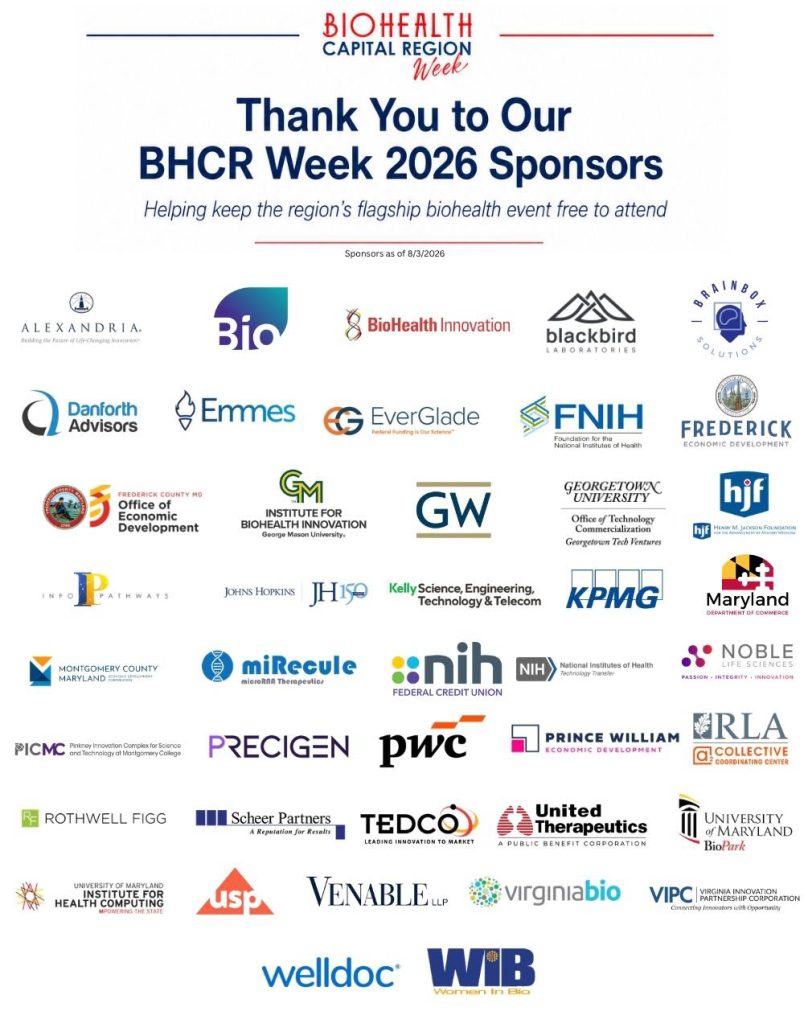
Thank You to Our Sponsors
BioHealth Capital Region Week remains free to attend thanks to the support of our sponsors. That is one of the things that makes this event different from many other industry conferences. Sponsor support helps ensure entrepreneurs, researchers, students, companies, investors, public-sector partners, and regional leaders can participate without cost barriers.
Every dollar raised goes toward producing the event and supporting the programming, visibility, logistics, and convening power that make BHCR Week possible.
Thank you to this year’s current sponsors and partners:
Alexandria Real Estate Equities
BioHealth Innovation, Inc.
BlackBird Labs
BrainBox, Inc.
Emmes
FNIH
George Mason University
George Washington University
Henry Jackson Foundation
Johns Hopkins University
Maryland Department of Commerce
Mirecule
Kelly Services
KPMG
Montgomery County Economic Development Corporation (MCEDC)
NIH Federal Credit Union (NIHFCU)
The NIH Office of Technology Transfer (OTT)
Noble Life Sciences
PIC MC
Precigen
PWC
Rose Li Associates
Rothwell, Figg, Ernst & Manbeck, P.C.
Scheer Partners
TEDCO
United Therapeutics
University of Maryland BioPark
University of Maryland Institute for Health Computing (UM-IHC)
US Pharmacopeia (USP)
Venable
VIPC
Virginia Bio
WellDoc
Women in Bio
Organizations interested in joining this group as sponsors are encouraged to contact BioHealth Innovation.
Sponsorship provides visibility across BioHealth Capital Region Week, including recognition through event materials, signage, the registration site, BHI communications, and onsite programming. Sponsors also gain access to the invite-only VIP Leadership Dinner, a smaller and more focused setting that brings together senior executives, investors, speakers, public-sector leaders, university partners, and key opinion leaders for high-value relationship building.
If you’re interested in joining your peers as a sponsor, email Rich Bendis at rbendis@biohealthinnovation.org AND Andy Eckert at aeckert@biohealthinnovation.org.
Register Now
BioHealth Capital Region Week is one of the region’s most important annual gatherings for biohealth leaders, entrepreneurs, investors, researchers, and ecosystem partners.
Register now for the Forum and Investment Conference, and apply for the Crab Trap Competition here: