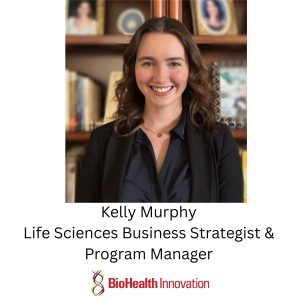
 By Kelly Murphy, BHI Life Sciences Business Strategist and Program Manager
At BioHealth Innovation, we have worked with hundreds of early-stage biohealth founders preparing for investor meetings, and increasingly, we are seeing AI tools enter the preparation process. When used well, AI can function like a “first-pass analyst” to quickly stress-test your narrative, identify gaps, and to help translate complex science into investor-friendly language. But while AI can accelerate early feedback cycles, it is not a substitute for deep domain expertise, investor insight, or strategic judgement that can be provided by experienced entrepreneurs and analysts. Knowing where it adds value and where it falls short is what separates founders who use it effectively from those who are lulled into a false sense of readiness.
What AI Can Do Well
AI excels at structure, clarity, and pattern recognition. For early-stage companies, this can be a major advantage.
First, AI can help ensure your pitch deck tells a coherent story. Many technical founders struggle to translate highly specialized science into a compelling narrative for an investor audience. AI can quickly flag when your problem statement is unclear, your value proposition is buried, or your slides don’t logically flow from unmet need to solution to market opportunity.
Second, AI is effective at benchmarking against common expectations and best practices. While it doesn’t “know” your company, it has been trained on patterns of successful communication. It can suggest whether you’re missing standard components that investors expect to see.
Third, AI can improve readability and tone. It can simplify jargon-heavy language, tighten messaging, and help tailor your pitch for different audiences (e.g., scientific vs. financial stakeholders). For teams preparing multiple versions of a deck with several authors, this can also significantly reduce iteration time and maintain consistency of tone.
Finally, AI can serve as a rapid feedback loop. Founders can get immediate reactions and refine their materials in real time, making subsequent expert feedback more focused and productive.
Where AI Falls Short
Despite these strengths, AI has meaningful limitations, especially in a field as nuanced as biohealth.
Most importantly, AI lacks true domain judgment and cannot assess the credibility of the claims being made. For example, AI may identify that a “clinical plan” slide is missing, but it cannot validate whether the plan itself is viable. For investors who understand the industry, a well-formatted but strategically flawed slide is worse than nothing at all.
AI also struggles with context. It does not understand your specific market dynamics, competitive positioning, or investor landscape. For example, it may suggest adding more market-sizing details without recognizing that your niche indication requires a more nuanced reimbursement or adoption strategy.
Another limitation is overgeneralization. AI often defaults to broadly applicable best practices that are not always strategically appropriate. In some cases, what makes a company compelling is precisely what deviates from the norm and AI may inadvertently steer founders toward a more generic narrative.
Finally, there is a risk of false confidence. A well-written output can give the impression of rigor, even when underlying assumptions haven’t been critically evaluated. AI also tends to compliment the user and encourage any prompt it is given, even if it is not well thought out. This is particularly dangerous when preparing for sophisticated investors who will probe deeply beyond surface-level messaging. A fun way to test this for yourself is to ask AI its thoughts on the worst business idea you can come up with and see how it responds.
Best Practices for Using AI Effectively: A Recommended Workflow
To get the most value from AI as a first-pass analyst, founders should treat it as a starting point and not as a decision-maker.
Step 1: AI-Assisted Drafting: Use AI early in the process to organize your thinking, pressure-test your story, and identify obvious gaps. Be specific in your prompts, for example, ask it to evaluate your deck from the perspective of a life sciences investor or to critique your value proposition based on clinical and commercial criteria. The more targeted the prompt, the more useful the output.
Step 2: Expert Gap Analysis: Layer in human expertise from advisors, mentors and/or consultants to bring the contextual understanding and strategic insight that AI cannot replicate. The goal is to use AI to elevate the quality of your materials so that expert feedback can focus on higher-value issues. These stakeholders can review positioning and help anticipate the questions investors will ask. A deck that has been reviewed by people who have sat on both sides of the table is stronger. At BHI, our role at this stage is to validate the substance beneath the narrative, not just the presentation.
Step 4: Investor mock session. Before your first real meeting, run a mock with someone who can simulate investor questions by probing your assumptions, challenging your data, and identifying non-obvious areas of improvement. AI cannot do this, but experienced specialists such as BHI’s entrepreneurs-in-residence and analysts can.
Throughout this process, remain critical of the output. Not all suggestions by AI will be relevant, and some may even dilute your differentiation or flatten nuance on complicated topics. Use AI as a tool to expand your perspective but rely on your team’s judgment to make final decisions.
The Bottom Line
AI is a powerful tool for improving the efficiency and clarity of early-stage pitch development. As a first-pass analyst, it can help founders move faster, communicate more effectively, and prepare more polished materials. But in biohealth, where scientific validity, clinical strategy, and market nuance are paramount, AI is only one piece of the puzzle. The strongest pitch decks we’ve seen at BHI combine innovative technologies with deep scientific expertise and strategic storytelling. AI can help you get there faster but it can’t get you there alone.
Work with BHI on Your Pitch Strategy
BioHealth Innovation supports early-stage biotech and medtech companies through go-to-market strategy, market analysis, and investor readiness. If you’re preparing for a fundraising round and want expert eyes on your pitch, beyond what AI can offer, we’d welcome the conversation.
Contact us at kmurphy@biohealthinnovation.org and jnelson@biohealthinnovation.org